Written by KRITIKA SINHA | IT SERVICES
You moved to the cloud because someone made a compelling case: lower infrastructure costs, better scalability, and faster delivery. AWS can deliver all of that. But for a lot of mid-sized enterprises, the invoice tells a different story. You are paying for resources that nobody is actively using. Storage for data nobody accesses. Databases provisioned for traffic volumes you rarely see. Monitoring that flags problems after the money has already gone.
This is not a rare edge case. It is what happens when cloud environments grow without the controls needed to keep spending in line with actual usage. Mid-sized organisations are particularly exposed to this problem. You are big enough to have a complex AWS environment, but you may not have a dedicated cloud cost management function that larger enterprises can afford to build internally.
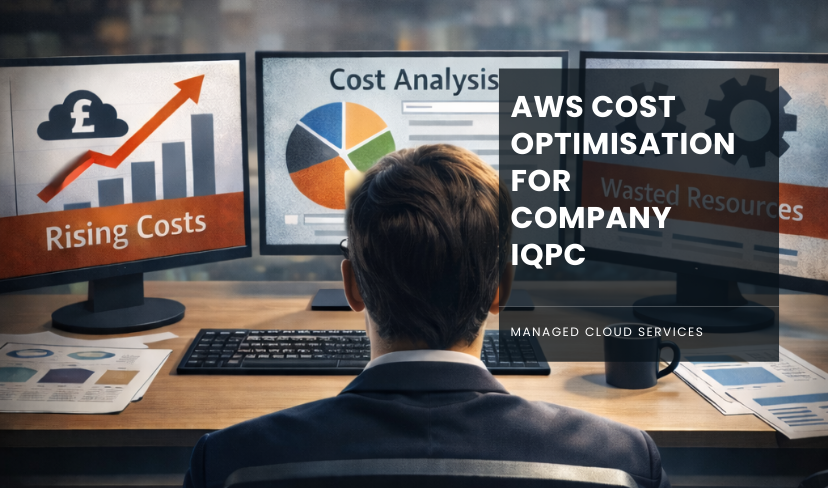
IQPC, one of the largest privately owned conference companies in the world, faced exactly this situation. Their AWS costs were climbing. The inefficiencies were real but not obvious. They needed expert intervention: someone to come in, find the waste, fix it, and manage it going forward. Transputec’s DevOps team did that work. The result was over $1 million saved per year.
This blog breaks down what AWS cost optimisation for mid-sized enterprises actually involves, where the waste typically hides, and what a structured approach looks like when it works.
What Is AWS Cost Optimisation?
AWS cost optimisation is the process of reducing unnecessary expenditure on Amazon Web Services by analysing usage patterns, rightsizing compute resources, implementing automated scaling, improving storage and network configurations, and establishing real-time cost monitoring. For mid-sized enterprises, it means paying only for what your business genuinely uses, without sacrificing performance or reliability.
It is not about spending less for the sake of it. It is about spending with precision. The same business outcomes, or better ones, for a materially lower monthly bill.
Why Do AWS Bills Keep Growing in Mid-Sized Organisations?
Cloud spend does not spike overnight. It creeps. And by the time someone notices, the waste has been accumulating for months, sometimes years. Mid-sized enterprises are often caught in a particular bind: the AWS environment has grown fast enough to become complex, but the internal team managing it is stretched thin across operational priorities.
These are the most common causes we find during an AWS environment assessment:
- Idle and underutilised resources: Servers and instances provisioned for a project that wrapped up six months ago, still running, still billing.
- Over-provisioned capacity: Teams request more compute than they need as a precaution. That precautionary buffer costs money every single day.
- No automated scaling: Fixed capacity set for peak load, running at full cost during off-peak hours when actual demand has dropped significantly.
- Poor storage governance: Old snapshots, redundant backups, and unattached EBS volumes accumulating costs with no review process in place.
- Limited cost visibility: Finance sees the consolidated bill at month-end. By then, the overspend has already happened and cannot be recovered.
- Legacy systems adding overhead: Tools and configurations that made sense at one point but now add cost and complexity without adding value.
According to Gartner, organisations waste an average of 30% of their cloud spend. For a mid-sized enterprise spending $3 million per year on AWS, that is $900,000 going to resources that deliver no business value. That number tends to get people’s attention quickly.
It is not about spending less for the sake of it. It is about spending with precision. The same business outcomes, or better ones, for a materially lower monthly bill.
Is Your AWS Risk Hiding in Plain Sight?
If you want clarity on your current AWS risk posture and a practical roadmap to strengthen it, speak with Transputec.
The IQPC Case: $1 Million Saved Through Structured AWS Optimisation
IQPC is not a small operation. Founded in 1973, they are the largest privately owned conference company in the world, running over 1,200 events per year across a global workforce of more than 1,244 employees. Their digital operations run on AWS, and at the scale they operate, cloud costs are a significant and closely watched line item.
The problem they brought to Transputec was straightforward to describe but difficult to fix without the right expertise: their AWS costs were growing, performance was inconsistent, and internal visibility into what was driving spend was limited. Underutilised resources, inefficient configurations, and a lack of comprehensive monitoring had turned a capable cloud environment into an expensive one.
IQPC engaged Transputec’s DevOps team to carry out a thorough assessment of their AWS environment and take over ongoing management. The programme covered four areas.
1. Resource Optimisation
Transputec’s team analysed IQPC’s usage patterns in detail to identify resources that were idle or running well below their provisioned capacity. Automated scaling solutions were implemented so that compute resources adjusted to real demand rather than sitting at peak capacity around the clock. IQPC stopped paying for capacity that delivered nothing.
2. Real-Time Cost Monitoring and Management
Advanced monitoring tools were deployed to give IQPC continuous visibility into its AWS cost drivers. Rather than discovering overspend at the end of a billing cycle, the team could identify anomalies as they emerged and respond before costs escalated. This shift from reactive to proactive management was significant.
3. Configuration Improvements
Existing setups were reconfigured to improve performance while reducing spend. This included optimising storage solutions, refining database management, removing legacy systems, including a Citrix layer that was adding cost and complexity without justification, and improving network configurations that had been creating unnecessary overhead.
4. Ongoing Managed Services
Rather than a one-time audit followed by a handback to the internal team, Transputec took on the ongoing management of IQPC’s AWS environment. Optimisation became a continuous process, not a snapshot review that would erode over time as the environment changed.
The outcome: IQPC reduced their AWS costs by over $1 million per year. System performance improved. Reliability increased. Juhel Ahmed, Head of IT at IQPC, described Transputec’s intervention as a game-changer, noting the team identified and resolved inefficiencies that IQPC would not have found on their own. Read the full case study
Why Mid-Sized Enterprises Are Particularly Vulnerable to Cloud Overspend?
The IQPC situation is not unique. We see the same patterns repeatedly when we assess AWS environments for mid-sized organisations. You have grown fast enough that your cloud footprint is genuinely complex. But the internal resources dedicated to managing that complexity have not kept pace.
Imagine this: your IT team is focused on keeping systems operational and managing the backlog of requests from the business. AWS cost optimisation requires dedicated time, specific tooling, and the pattern recognition that comes from working across many different environments. It is not the kind of work that gets prioritised when everything else is also urgent.
The result is that cloud overspend becomes structural. It is not caused by bad decisions. It is caused by good people who are stretched across too many priorities to give cloud cost management the focused attention it needs.
The most common thing we hear before an assessment is: ‘We think we are reasonably well-optimised.’ After the assessment, the reality is almost always different. The gap between perception and actual spend is consistently larger than people expect.
How to Start an AWS Cost Optimisation Programme?
A structured approach delivers results faster than trying to fix everything simultaneously. Here is a practical framework for mid-sized enterprises:
- Carry out a full resource inventory: List every resource in your AWS environment. Identify what is active, what is idle, and what nobody can account for. This step alone often surfaces significant waste.
- Analyse usage patterns: Review CPU, memory, and storage utilisation over the past 90 days. Resources running consistently below 20% utilisation are candidates for rightsizing or removal.
- Implement automated scaling: Set policies that adjust capacity in line with demand. For variable workloads, this one change alone can reduce compute costs substantially.
- Set up continuous cost monitoring: Use AWS Cost Explorer or a third-party monitoring tool to create dashboards that show spend in real time, broken down by service, team, and environment.
- Review reserved instances and savings plans: For predictable workloads, committing to reserved capacity in advance can reduce costs by up to 72% compared to on-demand pricing.
- Clean up storage: Remove unattached EBS volumes, expired snapshots, and S3 objects that have not been accessed in over 12 months. Storage costs accumulate silently.
- Audit legacy systems: Identify tools, layers, and configurations that were set up for historical reasons and may no longer be justifiable. As Transputec found with IQPC’s Citrix setup, removing the right things reduces both cost and complexity.
Each of these steps requires time and technical depth. The organisations that achieve the biggest improvements are those that bring in a partner with specific AWS expertise, rather than adding this work to an already stretched internal team.
What to Look for in an AWS Cost Optimisation Partner?
Not every managed service provider delivers the same results. Before committing to an engagement, ask these questions:
- Do they carry out a structured assessment before making recommendations, or do they go straight to proposing a solution?
- Can they show specific cost savings from previous client engagements, with real numbers rather than percentages alone?
- Do they offer ongoing management, or is it a one-time review with no follow-through?
- What monitoring and cost reporting will you receive, and with what frequency?
- Do they hold AWS certifications or partnership status that gives them access to AWS tooling, training, and specialist support?
Transputec holds an Advanced Tier partnership status with AWS. Every engagement begins with a structured assessment of the client’s environment because recommendations without evidence are guesswork. What you get from that assessment is a clear, data-backed picture of where your money is going, a prioritised plan to fix the biggest sources of waste, and the team to carry out the work.
Conclusion
AWS cost optimisation for mid-sized enterprises is not about cutting your cloud budget. It is about making sure every pound or dollar you spend on AWS is doing useful work. Cloud environments that grow without active governance accumulate waste in predictable and fixable ways: idle resources, over-provisioned capacity, inefficient configurations, legacy systems that should have been removed, and no real-time visibility into what is driving costs.
IQPC came to Transputec with exactly these problems. Through a structured assessment of their AWS environment and an ongoing managed services engagement, they reduced their cloud spend by over $1 million per year while improving both system performance and reliability. If your AWS bill is rising without a clear explanation, or if your environment has never had a formal optimisation review, the cost of inaction is already built into your monthly invoice. The question is not whether to optimise. It is how quickly you want to start seeing the savings.

Ready to Experience the Transputec Difference?
Contact us today to schedule a consultation with our experts.
FAQs
1. How long does an AWS cost optimisation assessment take with Transputec?
Transputec’s initial AWS environment assessment typically takes one to two weeks, depending on the size and complexity of your environment. This covers a full resource inventory, analysis of usage patterns over the past 90 days, identification of waste and inefficiencies, and a prioritised recommendations report. The aim is to give you a clear, evidence-backed picture quickly so that implementation can begin without delay. For mid-sized enterprises with established AWS footprints, the assessment frequently surfaces savings opportunities that justify the engagement cost many times over.
2. What level of savings can a mid-sized enterprise realistically expect from AWS cost optimisation?
Results depend on the current state of your environment, but organisations that go through a structured AWS cost optimisation programme typically save between 20% and 40% of their total cloud spend. In the case of IQPC, Transputec’s managed services engagement delivered savings of over $1 million per year. We will not quote a savings figure before completing an assessment, because the honest answer comes from looking at what you are actually running, not from applying a generic benchmark. What we can tell you is that environments which have grown without active cost governance almost always carry more waste than the internal team realises.
3. Do we need to rebuild our AWS setup, or can Transputec optimise what we already have?
Transputec works with your existing AWS environment. The optimisation process involves rightsizing resources, reconfiguring inefficient setups, implementing automated scaling, improving storage and database configurations, and building monitoring that gives you ongoing visibility. In most cases, no migration or rebuild is required. The IQPC engagement involved improving and reconfiguring what was already in place. The most significant structural change was removing a Citrix layer that was adding cost and complexity without a clear operational justification. Everything else was optimised within the existing architecture.
4. How does Transputec manage AWS costs on an ongoing basis after the initial optimisation work?
After the initial optimisation, Transputec manages your AWS environment continuously. Our team monitors usage patterns, identifies new inefficiencies as your workload evolves, and manages scaling, storage, and configuration on your behalf. You receive regular cost reporting so that you have full visibility without needing to manage it internally. This ongoing management is what makes the savings sustainable. Without continuous management, optimised environments drift back toward waste as usage patterns change, new resources get provisioned, and old ones are not retired. The IQPC engagement was structured as ongoing managed services from the outset, which is why the savings were sustained and built on over time.
5. Our internal IT team already manages our AWS environment. What does Transputec bring that they cannot?
Internal IT teams are typically focused on keeping systems operational and managing the backlog of business requests. AWS cost optimisation requires dedicated time, specific tooling, and the pattern recognition that comes from working across many different environments of different sizes and sectors. Transputec’s DevOps engineers bring that breadth of experience. They have carried out optimisation programmes across multiple organisations and know where to look for waste that is not obvious from the inside. Juhel Ahmed, Head of IT at IQPC, noted directly that Transputec identified and resolved inefficiencies his team would not have found on their own. That is not a criticism of internal teams. It is the straightforward advantage of specialised focus applied to a specific and technically demanding problem.