Written by KRITIKA SINHA | IT SERVICES
Most business leaders believe that moving to the cloud means the provider handles the security. This is a dangerous assumption. Amazon Web Services (AWS) operates on a shared responsibility model. They secure the “cloud” (the physical data centres and hardware), but you are responsible for security “in” the cloud (your data, your configurations, and your users). If a developer leaves an S3 bucket open to the public or an admin uses a weak password without multi-factor authentication, the resulting breach is on your watch, not theirs.
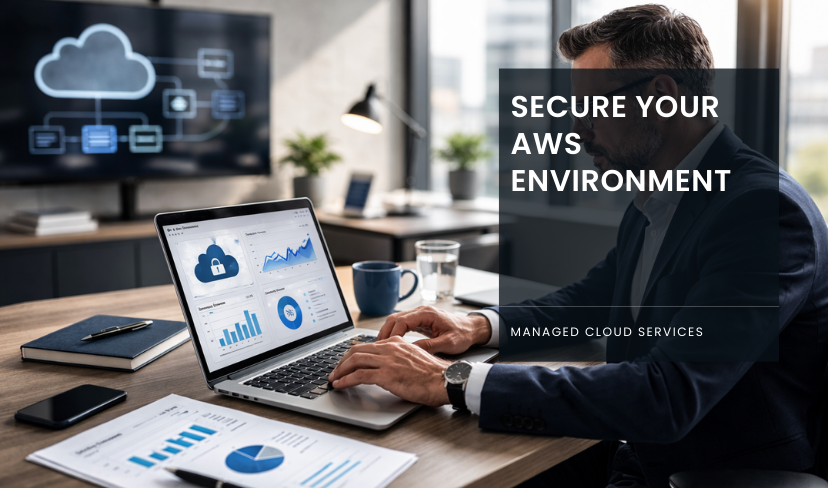
To Secure Your AWS Environment, you must move beyond the “set it and forget it” mindset. A breach is rarely a result of a sophisticated zero-day attack; it is usually the result of a simple configuration error that went unnoticed for months. For a COO or CIO, the goal is to build an infrastructure that is resilient enough to support growth without becoming a liability.
What is AWS Security?
AWS security is the collection of controls, policies, and technologies used to protect data, applications, and infrastructure within the Amazon Web Services ecosystem. It relies on the Shared Responsibility Model, where the customer is responsible for configuring identity access management (IAM), encrypting data, and maintaining network firewalls to ensure business continuity and regulatory compliance.
The True Cost of "We’ll Fix It Later"
In the high-growth startup world, speed is everything. You push code fast to stay ahead of the competition. But if you ignore how to secure AWS infrastructure properly during that growth phase, you are building on sand. A single data leak can cost an SME an average of £3.4 million when you factor in fines, legal fees, and the devastating loss of customer trust.
We see this often at Transputec. Companies come to us after an audit fails or, worse, after they notice unusual billing spikes caused by hackers mining cryptocurrency on their instances. By then, the damage is done. Proactive security is not a cost centre; it is an insurance policy for your brand’s reputation.
The Pillars of a Secure AWS Environment
To protect your assets, you need a structured approach to cloud governance. It is not enough to just turn on a few settings. You need a framework that scales as your business scales.
1. Identity and Access Management (IAM)
The most common entry point for attackers is compromised credentials. If your staff are logging in with simple passwords and no secondary verification, your front door is wide open.
- Principle of Least Privilege: Users should only have the permissions necessary to do their job. A marketing manager does not need administrative access to the database.
- MFA is Non-Negotiable: Every single account, especially root accounts, must have Multi-Factor Authentication enabled.
- Rotate Keys: Programmatic access keys are often hard-coded into applications and forgotten. Regular rotation reduces the window of opportunity for an attacker.
2. Infrastructure Protection and Firewalls
Your virtual private cloud (VPC) is your digital perimeter. Without proper AWS security best practices applied to your networking, an attacker who gains access to one small area can move laterally across your entire system.
Use security groups and network ACLs to restrict traffic. If a service does not need to be on the public internet, keep it in a private subnet. Using tools like AWS WAF (Web Application Firewall) can block common web exploits before they even reach your servers.
3. Data Encryption
If the worst happens and data is stolen, encryption is your last line of defence. If the data is encrypted at rest and in transit, it is useless to the thief. AWS makes this relatively simple with the Key Management Service (KMS), but it must be configured correctly across all services, from S3 buckets to EBS volumes.
Is Your AWS Risk Hiding in Plain Sight?
If you want clarity on your current AWS risk posture and a practical roadmap to strengthen it, speak with Transputec.
Why an AWS Security Assessment for Enterprises is Essential?
If you haven’t looked at your configurations in six months, they are likely outdated. AWS releases hundreds of new features and security patches every year. An AWS security assessment for enterprises provides a clear-eyed view of your current posture.
At Transputec, our assessment doesn’t just look for bugs. We look at your business logic. We ask:
- Is your data residency compliant with GDPR or industry-specific regulations?
- Do you have a disaster recovery plan that has actually been tested?
- Are you overspending on resources that are poorly configured?
As an AWS Advanced Tier Partner, we use the Well-Architected Framework to audit your environment across five pillars: operational excellence, security, reliability, performance efficiency, and cost optimisation. This ensures that your security efforts also lead to a more efficient and cheaper cloud bill.
Bridging the Gap Between Compliance and Security
There is a difference between being “compliant” and being “secure.” You can pass a checkbox audit and still be vulnerable. However, for sectors like finance, healthcare, or legal, AWS compliance is a legal necessity.
Navigating frameworks like ISO 27001, SOC2, or PCI-DSS in a cloud environment is complex. We help automate the evidence collection. By using automated tools to monitor your environment, we can detect when a setting drifts away from a compliant state and fix it before it becomes a problem. This level of cloud governance allows you to focus on your customers while we handle the regulatory red tape.
Common Mistakes SMEs Make in AWS
Small and medium-sized enterprises often fall into the trap of thinking they are “too small to be a target.” In reality, hackers use automated scripts to find any vulnerable AWS instance, regardless of company size.
Leaving Default Settings: Many AWS services come with broad default permissions. These must be tightened immediately.
Poor Logging: If you aren’t using AWS CloudTrail or Amazon GuardDuty, you won’t even know you’ve been breached until it’s too late. Logging provides the “black box” recorder for your cloud.
Ignoring Shadow IT: Sometimes, developers spin up temporary environments to test a feature and forget to shut them down. These unmonitored “ghost” environments are prime targets for attackers.
Moving Toward a Collaborative Partnership
The old way of working with an MSP was transactional. You called them when something broke. In the modern cloud era, that model fails because a “broken” security setting doesn’t always stop the system from running; it just leaves it exposed.
A collaborative partnership means we are proactive. We look at your roadmap for the next twelve months and align your AWS infrastructure to support it. If you are planning to expand into new territories, we ensure your cloud governance policies account for local data laws. If you are expecting a surge in traffic, we ensure your security scales automatically with your load balancers.
By working with an AWS Consulting Partner like Transputec, you aren’t just buying a service; you are gaining a strategic ally. We help you navigate the complexity of the cloud so you can drive your business forward with confidence.
Conclusion
To secure your AWS environment before a breach occurs, you need to treat security as a core part of your cloud operating model, not an afterthought. That means strong identity controls, tight network and data‑layer protections, clear cloud governance, continuous monitoring, and regular assessments aligned with AWS security best practices.
Transputec, as an AWS Consulting Partner and AWS Advanced Tier Partner, can help you implement these controls, run an AWS security assessment for enterprises, and embed security into your AWS infrastructure so you can scale with confidence.

Ready to Experience the Transputec Difference?
Contact us today to schedule a consultation with our experts.
FAQs
1. How often should we run an AWS security assessment for enterprises?
At least annually, and after major architecture changes. High-growth businesses should consider biannual reviews. Transputec supports recurring assessments aligned to your risk profile and compliance roadmap.
2. Is AWS secure by default?
AWS infrastructure is secure. Your configuration is your responsibility. Misconfigured IAM roles, open storage buckets, and poor cloud governance create exposure. Transputec helps implement AWS security best practices tailored to your environment.
3. What is the difference between AWS compliance and AWS security?
Security focuses on protecting systems and data. Compliance proves you meet regulatory or contractual standards. Transputec aligns technical controls with compliance frameworks so audits become predictable, not stressful.
4. Can SMEs justify investing in AWS security?
Yes. SMEs are frequently targeted because attackers assume weaker controls. A breach can threaten business survival. Proactive security costs less than recovery. Transputec works with SMEs to right-size investment without over-engineering.
5. How does an AWS Consulting Partner improve governance?
An AWS Consulting Partner brings structured methodology, independent oversight, and experience across sectors. Transputec embeds cloud governance into operational processes so security becomes repeatable and scalable.