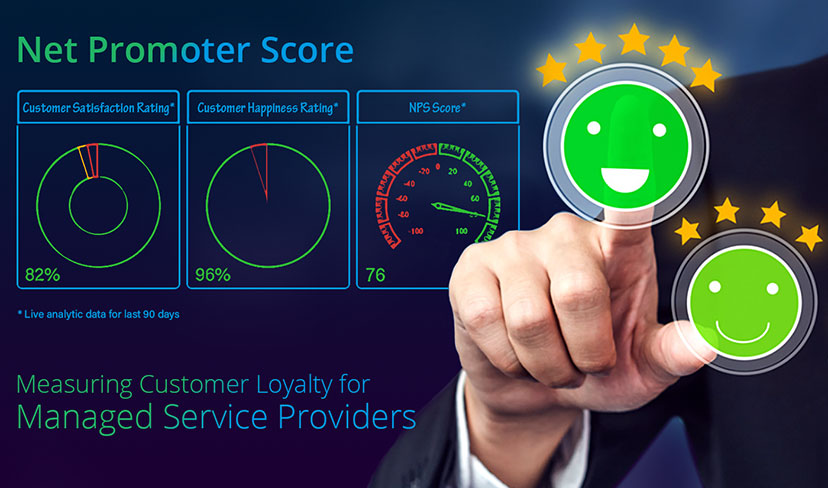
If you run or buy managed services, customer loyalty matters just as much as technical capability. You can have the right tools, experienced engineers, and a strong service catalogue, but if customers do not trust you enough to stay, renew, and recommend you, growth becomes harder to sustain.
That is why Net Promoter Score, usually shortened to NPS, remains such a widely used metric. Bain’s Net Promoter System describes NPS as the result of asking customers how likely they are to recommend your company, product, or service to a friend or colleague on a 0 to 10 scale. Customers who give 9 or 10 are classed as promoters, 7 or 8 are passives, and 0 to 6 are detractors. Your score is the percentage of promoters minus the percentage of detractors.
For managed service providers, that matters because the relationship is ongoing. You are not measuring a single purchase. You are measuring whether clients feel confident enough in the overall service experience to recommend you to somebody else. That makes NPS especially useful for businesses delivering long-term support, security, cloud management, and workplace technology services.
Transputec’s own website reflects that service-led model clearly. The business positions itself as a managed IT support provider delivering 24/7 managed IT services, cyber security services, managed cloud services, AI-powered IT solutions, Microsoft modern workplace services, and tailored IT strategies. It also highlights live customer satisfaction data as part of its wider “Why Partner” proposition.
What NPS actually tells you
NPS is often treated as a simple number on a dashboard. That is useful, but it is only the start.
What NPS really gives you is a high-level signal about loyalty. It tells you whether your customers are more likely to promote your business than discourage others from using it. Medallia describes NPS as an index ranging from -100 to 100 that measures willingness to recommend a company’s products or services and is used as a proxy for overall satisfaction and loyalty.
For a managed service provider, that broader view matters. A client might be satisfied with a single resolved ticket but still feel uncertain about the overall relationship if communication is poor, reporting is weak, or proactive support is missing. NPS helps you look past one-off interactions and assess how the customer feels about the service as a whole.
Why NPS matters for managed service providers
Managed services are different from many other service models because customers experience them continuously. They rely on you over time, often across several functions and teams.
That is especially true when you are delivering services such as managed IT services, a managed IT service desk, managed cloud services, cyber security services, remote IT support, or a Microsoft modern workplace. These are not one-time projects. They are ongoing service relationships that shape day-to-day operations.
That means loyalty is usually built through repeated service experiences such as:
- How Quickly you respond when something goes wrong
- How Clearly you communicate during incidents
- How Consistently you deliver against expectations
- How Proactively you help reduce future issues
- How Well you align IT support with business goals
Transputec’s IT support pages underline this same point by positioning support around always-on service, customer happiness, and accessible assistance. Its remote IT support page also publicly highlights 99.4% customer happiness and 24×7 support.
How to calculate NPS properly
The formula itself is simple:
NPS = Percentage of promoters – percentage of detractors
Passives are included in the survey response base, but they are not directly included in the subtraction. So if 60% of respondents are promoters and 20% are detractors, the NPS is 40. That is the standard approach described by Bain and other major customer experience platforms.
The challenge is not the maths. The challenge is using the score properly.
If you only report the headline number, you miss most of the value. For a managed service provider, NPS becomes much more useful when you connect it to service lines and customer journeys, such as AWS Landing Zones, device as a service, Microsoft Sentinel SOC, customer satisfaction data, and outsourced IT support services.
What a “good” NPS looks like
This is where many MSPs overcomplicate things.
There is no universal “perfect” NPS because scores vary by industry, customer base, service model, timing, and survey method. A stronger approach is to look at direction and consistency rather than chase a single benchmark.
If your score is improving over time, that tells you something useful. If one customer segment scores you highly and another does not, that tells you something useful too. The real purpose of NPS is not to give you a vanity number. It is to help you learn where loyalty is being built and where it is being weakened.
Transputec’s customer satisfaction content makes that point by linking NPS with loyalty, repeat business, revenue growth, and early issue detection. Those are exactly the kinds of outcomes MSPs should be looking at when they analyse loyalty properly.
How to analyse NPS instead of just reporting it
The real value of NPS comes from the analysis behind the score.
Segment the feedback
Break down responses by customer type, service line, contract value, or stage of the relationship.
For example, are clients using managed IT services more positive than customers using only reactive support? Are device as a service customers more satisfied because the service model is simpler to consume? Are newer clients less positive because onboarding needs improving?
Look for patterns in the comments
The written feedback is often more useful than the score itself.
You may find that customers praise fast response times but complain about strategic guidance. Or they may like your engineers but feel reporting and communication need work. Those patterns tell you where loyalty is actually being won or lost.
Compare NPS with service performance
NPS is much stronger when you view it alongside operational data. If your score drops during a period of higher ticket volume, slower response times, or repeated escalations, that is a practical signal rather than just a customer sentiment issue.
That is why service-desk maturity matters. Transputec’s own service pages place heavy emphasis on structured support, operational governance, and always-on assistance, which all feed directly into how customers experience the service.
Pay close attention to detractors
Promoters help you understand what is working. Detractors help you understand where you are at risk.
For MSPs, detractor comments often point to repeated friction rather than one isolated problem. Common themes can include unclear communication, slow escalation, weak onboarding, poor visibility, or limited proactive advice. Even when the technical service is acceptable, those issues can still damage loyalty.
Why NPS should not be your only metric
NPS is valuable, but it should not stand alone.
For managed service providers, loyalty is better understood when you also look at renewal rates, churn, service satisfaction, complaint trends, reference willingness, and account growth. NPS gives you one important lens, but it does not capture everything by itself.
That broader view fits well with Transputec’s positioning across managed IT services, cyber security services, cloud services, and customer satisfaction data. The message across the site is not just about fixing incidents. It is about building dependable long-term service relationships.
Turning NPS into action
The best NPS programmes do more than collect data. They use it to improve service.
A practical approach usually includes:
- Closing The loop with detractors quickly
- Sharing Feedback with service and account teams
- Fixing Root causes, not just individual complaints
- Reviewing Results by service line and customer segment
- Measuring Whether service changes improve future scores
That is where NPS becomes commercially useful. It helps you protect recurring revenue, improve retention, and strengthen referrals. In managed services, customer loyalty is rarely won by one grand gesture. It is built through consistent delivery, reliable support, and communication that makes clients feel looked after.
Customer loyalty in managed services is earned over time
For MSPs, loyalty is not created by technical delivery alone. It is shaped by the full service experience.
If you respond quickly, communicate clearly, solve problems properly, and keep improving the relationship, NPS will often reflect that. If those basics slip, the score usually shows it sooner or later.
That is what makes NPS such a useful metric for managed service providers. It gives you a simple, repeatable way to see whether your service experience is strong enough that customers would recommend you.
If you want to see how a service-led MSP presents customer satisfaction, operational support, and long-term service value, explore Transputec’s managed IT services, managed IT service desk, cloud services, cyber security services, and customer satisfaction data. The strongest managed service relationships are built on trust, consistency, and a service experience that customers are happy to recommend.