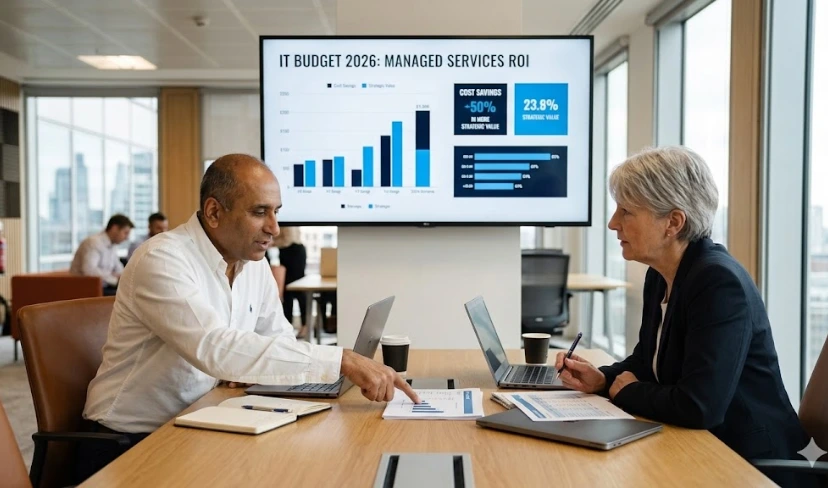
Budget season brings the same conversation every year. The CIO comes to the table with a request for increased IT spend. The CFO asks what the business is getting for it. And too often, the IT services provider sitting at the heart of that spend becomes the easiest target for cuts.
An IT services provider in the UK (commonly known as a managed service provider or MSP) manages, monitors, and supports your organisation’s IT infrastructure under a fixed monthly contract. For CFOs, the core financial benefit is the shift from unpredictable, reactive IT expenditure to a stable, budgeted operational cost, typically priced per user per month and inclusive of support, security, and monitoring.
In 2026, that dynamic has shifted. Technology costs are rising, cyber threats are escalating, and the pressure to demonstrate return on every pound invested is higher than ever. For CIOs and IT leaders at UK businesses, the challenge is not just delivering excellent technology; it is speaking to the CFO in the financial language they need to hear.
This guide gives you the frameworks, the numbers, and the arguments to make that conversation land.
Why Is the CFO Scrutinising IT Spend More Closely in 2026?
Gartner research indicates that 75% of CFOs expect technology budgets to increase in 2026, with nearly half anticipating rises of 10% or more. At the same time, economic conditions are making finance teams more demanding about proof of value.
The result is that CIOs are being asked to justify the spending they once took for granted. Managed IT support UK, outsourced IT services UK, cybersecurity, cloud infrastructure — all of it is now subject to scrutiny.
The good news is that the financial case for working with an IT services provider in the UK has never been stronger. You just need to know how to frame it. Our guide on managed IT services costs for UK businesses provides a useful background before you build your numbers.
Ready to Experience the Transputec Difference?
Contact us today to schedule a consultation with our experts.
Get a Strategic ConsultationThe Business Case for an IT Services Provider UK: 5 Arguments That Land
1. Replace Unpredictable CapEx with a Fixed Monthly OpEx
The first argument is simple: predictability.
In a break-fix or under-resourced in-house IT model, costs arrive as surprises. A failed server, an emergency contractor, and an unplanned upgrade each hit the P&L outside of budget. For a CFO trying to forecast the year, that unpredictability is a risk in itself.
A qualified IT services provider in the UK replaces that volatility with a fixed, per-user monthly fee. Standard UK managed IT support packages in 2026 range from £60 to £90 per user per month for a full suite of monitoring, helpdesk, patching, and cybersecurity. That is a number the finance team can model accurately 12 months in advance.
The shift from CapEx to OpEx also has balance sheet benefits that CFOs often appreciate, reducing the need for large, periodic capital investments in hardware and infrastructure.
2. Quantify the Cost of Downtime You Are Currently Absorbing
Most businesses significantly underestimate what IT downtime actually costs. UK businesses lose an estimated £3.6 million per year on average to IT downtime, at a rate of around £258,000 per hour in lost productivity and revenue.
For SMEs specifically, the annual cost of downtime averages £7,500 per business, and 92% of UK organisations take more than 24 hours to fully recover from a major outage.
Present these numbers in the context of your own business. How many hours of downtime did your team experience last year? What is the average hourly cost of your workforce? Multiply it out and put it on a slide. The case for 24/7 managed IT services, proactive monitoring that catches issues before they escalate into outages, almost always pays for itself against the cost of unplanned disruption. Read more in our analysis of the real cost of IT downtime for UK businesses.
3. Show the True Cost of In-House IT vs Outsourced IT Services in the UK
One of the most compelling arguments a CIO can make is a fully loaded cost comparison between running IT in-house and working with an IT services provider in the UK.
In-house IT costs are rarely calculated honestly. They include salary, employer’s national insurance, pension contributions, recruitment fees, training, hardware, software licences, and cover during absences. A single mid-level IT engineer in London costs between £50,000 and £70,000 all-in before a single laptop is purchased.
A proper IT cost savings outsourcing UK analysis typically shows that a managed model delivers the equivalent of a full team, help desk, security, monitoring, project capability, and strategic advisory at a fraction of that cost. CompTIA found that 62% of businesses adopting managed IT services reported improved operational efficiency, with 59% reporting direct cost savings. See how managed IT services help businesses scale faster for a practical breakdown of what that looks like in practice.
4. Make the Cybersecurity Risk Case in Financial Terms
Cybersecurity is increasingly a board-level concern, and for good reason. The average cost of a cyber breach for a UK SME now sits between £8,000 and £15,000. For larger organisations, the damage runs to hundreds of thousands when you factor in remediation, regulatory fines under the UK GDPR, and reputational impact.
The Information Commissioner’s Office has the power to issue fines of up to £17.5 million or 4% of global annual turnover for serious breaches. Frame the cybersecurity component of your IT support UK package as risk mitigation with a clear financial value: if the annual cost of managed cybersecurity coverage is £X, and the probability-adjusted cost of a single breach is significantly higher, the maths is straightforward for any CFO.
An experienced IT services provider in the UK includes security operations, threat monitoring, and incident response as standard. For a detailed cost breakdown of the security component, see our guide on managed cybersecurity services costs.
5. Frame IT as a Growth Enabler, Not an Overhead
The final argument shifts the conversation entirely. Rather than defending IT as a cost, position your IT services provider in the UK as the infrastructure that enables the business to grow.
Scalability, speed of onboarding, reliable remote access, and cloud agility – all of these are things a strong managed IT support UK partner delivers. When the business wants to open a new office, hire 30 people in a quarter, or launch a new service, your IT partner is the reason it happens without a six-month infrastructure project.
This reframing, from IT as a cost centre to IT as a growth capability, is frequently the argument that closes the budget conversation with a CFO, because it connects technology investment directly to revenue potential.
How to Structure the Conversation with Your CFO?
When presenting the business case, keep it finance-first and concise. A clear structure helps:
- Current state cost: Total IT spend last year, including all in-house staffing, break-fix, downtime, and hidden costs
- Risk exposure: Estimated annual cost of downtime, cyber incidents, and compliance failures if the status quo continues
- Proposed model: Fixed monthly per-user fee from an IT services provider UK, fully inclusive of support, monitoring, and security
- Year 1 comparison: Show the delta. In most cases the managed model costs the same or less, with significantly lower risk
- Three-year view: Show the compounding benefit of proactive IT management and predictable spend over time
If you need strategic support in building and presenting this case to your leadership team, our IT consultancy services are designed exactly for that. For organisations without a dedicated CIO, our virtual CIO service gives you board-level IT leadership as part of your managed IT services ROI 2026 investment.
Conclusion
The CFO’s job is to protect the business financially. The CIO’s job is to ensure technology serves that mission. When those two perspectives align, IT budget conversations stop being defensive and start being strategic.
An experienced IT services provider in the UK does not simply reduce costs. It changes the nature of the conversation entirely: predictable spend, quantified risk reduction, and a clear link between IT investment and business growth are the language every CFO understands.
Transputec has been helping UK organisations build and justify their IT investment for over 35 years. If you are preparing for your next budget conversation, contact our team and find out exactly how an IT services provider in the UK can transform your business case.
FAQs
How do I justify managed IT services spend to my CFO in the UK?
Build the case around three numbers: the total current cost of in-house IT including all hidden costs, the estimated annual cost of downtime and cyber risk at status quo, and the fixed monthly fee from a managed IT services provider UK. In most cases the managed model reduces total cost and risk simultaneously, which is the outcome any CFO wants to see.
What is the ROI of managed IT services in 2026?
Most UK businesses see measurable ROI within 3 to 6 months of adopting managed IT services. CompTIA research found that 62% of businesses reported improved operational efficiency and 59% reported direct cost savings after switching to a managed model. The ROI is strongest when you account for avoided downtime, reduced cyber incidents, and lower recruitment and training overhead.
How much does an IT services provider UK cost in 2026?
Standard UK managed IT support packages range from £60 to £90 per user per month for a full suite of monitoring, helpdesk, patching, and cybersecurity. Larger or more complex environments may attract higher rates depending on the scope of services included. Transputec offers tailored pricing based on your organisation’s specific needs and scale.
What IT cost savings can UK businesses achieve by outsourcing IT?
IT cost savings from outsourcing in the UK typically come from four areas: reduced staffing overhead, elimination of unplanned break-fix costs, avoided downtime losses, and optimised software licensing. A properly structured engagement with an IT services provider in the UK commonly identifies a 12% saving in unused software subscriptions within the first 90 days of partnership.
What is a virtual CIO and how does a managed IT provider support it?
A virtual CIO is a strategic IT leadership service delivered as part of your managed IT services engagement, giving smaller organisations access to board-level IT strategy without the full-time cost. A strong IT services provider in the UK offers this alongside day-to-day support, creating a single point of accountability for your entire technology function. Read more about virtual CIO services and what they mean for your IT investment.