Written by SONNY SEHGAL | CEO
You are paying for Microsoft 365. Your people use it every day. And yet, the productivity gains you expected when you signed that licence agreement have not quite materialised. Meetings still drag. Files still get lost. Teams channels are either ghost towns or impossible to navigate. And somewhere in your organisation, people are duplicating work because they do not know it already exists in SharePoint.
This is not a Microsoft problem. It is an adoption and intelligence problem. And it is costing you more than you realise.
According to SaaS management firm CoreView, 44% of Microsoft 365 licences are either underutilised or oversized across the average business. That means nearly half your investment is sitting idle. Businesses that actively identify and reassign inactive licenses can cut their Microsoft 365 costs by up to 14%, without losing any capability at all.
The answer is not to cancel subscriptions or downgrade plans without evidence. The answer is to get smarter about how your organisation actually uses the platform. That is precisely where Work IQ Microsoft 365 changes the conversation.
What Is Work IQ in Microsoft 365?
Microsoft Work IQ is the intelligence layer that powers Microsoft 365 Copilot. Introduced at Microsoft Ignite 2025, it sits behind every Copilot experience and gives it the ability to understand not just content, but context. It learns how your organisation works: who collaborates with whom, what projects are active, where communication patterns break down, and where time is genuinely being spent versus wasted.
Think of it this way: if Copilot is the assistant, Work IQ is the briefing that makes that assistant actually useful. Without it, AI tools generate generic output. With it, they produce advice, actions, and summaries that are specific to your teams, your workflows, and your business priorities.
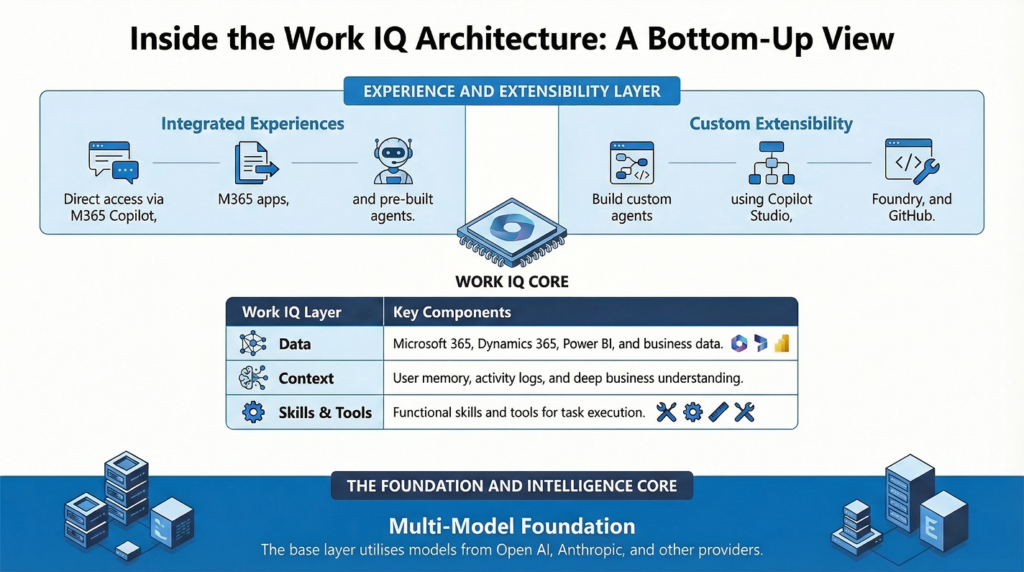
Work IQ operates across three integrated layers:
- Data: secure access to your Microsoft 365 tenant, including emails, Teams chats, SharePoint documents, OneDrive files, and meeting transcripts.
- Context: a semantic understanding layer that maps collaboration patterns, identifies relationships between people and projects, and builds a memory of how work happens.
- Skills and tools: agentic capabilities that allow Copilot and AI agents to take precise actions, retrieve specific content, and execute multi-step workflows without requiring users to prompt from scratch.
This is not employee surveillance. Work IQ uses aggregated, permission-respecting signals to improve AI accuracy and organisational intelligence. Individual data stays protected by existing security and compliance policies.
The Real Cost of Microsoft 365 Underutilisation
Before talking about what to fix, it helps to understand what is actually broken.
Microsoft’s 2025 Work Trend Index found that employees using Microsoft 365 are interrupted an average of 275 times per day, roughly once every two minutes, by meetings, email alerts, or chat notifications. One in three workers says the pace is no longer sustainable. Evening meetings have increased by 16%. And 68% of employees report they do not get enough uninterrupted focus time.
This is not a workload problem in isolation. It is a Microsoft 365 productivity problem rooted in poor configuration, low adoption, and a near-complete absence of data about how the platform is actually being used.
Here is a scenario that plays out in organisations of every size:
A business pays for Microsoft 365 E5 licences across its 200-person workforce. Most employees use Outlook and Teams for chat. SharePoint is set up but rarely used correctly. Viva Insights is licensed but never activated. Copilot is available, but only a handful of people have touched it. The IT team has no visibility into which tools are generating value and which are just adding noise. Leadership asks whether they are getting ROI. Nobody has a credible answer.
This is Microsoft 365 underutilisation in its most common form. It is not dramatic. It is quiet, persistent, and expensive.
Unlock the Full Value of Your Microsoft 365 Investment
Transputec's Microsoft 365 specialists can assess your current adoption posture, identify cost and productivity opportunities, and build a clear roadmap for improvement. Whether you need licence optimisation, Copilot deployment support, or a full Microsoft 365 governance review, we are ready to help.
How Microsoft 365 Usage Analytics Reveals the Truth?
The first step to fixing the problem is measuring it. Microsoft provides several native workplace productivity analytics tools that most organisations either ignore or do not know exist.
1. Microsoft Adoption Score tracks how your workforce uses the core Microsoft 365 applications. It benchmarks your organisation against businesses of a similar size. It shows where adoption is strong and where it has stalled. It covers communication, collaboration, mobility, content creation, and meetings.
2. Microsoft Viva Insights goes deeper. It surfaces behavioural patterns: meeting effectiveness, collaboration hours, after-hours work, and focus time. The Copilot Analytics dashboard within Viva Insights shows specifically how Copilot is being used across your organisation, which departments are getting value and which have adopted it in name only. A Forrester Total Economic Impact study commissioned by Microsoft found that organisations using Viva can achieve a 327% return on investment with payback in under six months, including a 75% reduction in time spent searching for information.
3. Microsoft 365 Usage Analytics in the admin centre provides cross-product dashboards covering the past 12 months of usage data. It is free. It is built in. And the vast majority of IT managers never open it.
The data is already there. The question is whether you have the process, the expertise, and the time to act on it.
Work IQ and Microsoft Copilot Analytics: The Intelligence Layer
Microsoft Work IQ takes Microsoft 365 usage analytics to a fundamentally different level. Standard dashboards tell you what happened. Work IQ tells you why, and then adjusts Copilot’s behaviour accordingly.
It builds what Microsoft calls a Work Chart: a map of real collaboration patterns in your organisation. Not the org chart, which reflects hierarchy. The actual working relationships that drive output. Work IQ identifies who your people genuinely work with, what projects matter most to them, and where friction consistently appears.
Microsoft Copilot analytics within this framework allows IT leaders and business decision-makers to:
- See which Copilot features are driving measurable time savings and which are underused.
- Identify teams that have adopted AI effectively versus teams that need targeted support.
- Track changes in meeting patterns, communication volume, and collaboration flow over time.
- Connect Microsoft 365 performance insights directly to business outcomes rather than just activity metrics.
For an IT leader or CIO, this shifts the conversation entirely. You are no longer defending a technology purchase by pointing to login rates. You are presenting evidence of behavioural change, cost reduction, and productivity gains, backed by enterprise collaboration analytics that are specific to your organisation.
Microsoft 365 Adoption Challenges: Why Most Programmes Stall
Organisations invest in Microsoft 365 and then underinvest in helping people use it well. That is the root of most Microsoft 365 adoption challenges.
Common patterns include:
- Tool proliferation without purpose: Teams, Yammer, SharePoint, Viva Engage, and email all exist simultaneously, with no clear policy on which to use when. People default to email. Collaboration tools sit idle.
- No training after go-live: Rollout happens, a few lunch-and-learn sessions run, and then everyone is left to work it out. Most people revert to what they know.
- Poor collaboration in Microsoft Teams: Channels are created without governance. Files are posted without structure. New joiners cannot find anything. Teams becomes a dumping ground rather than a collaboration space.
- No measurement: Without tracking Microsoft 365 adoption insights, nobody knows whether tools are being used effectively. IT teams cannot justify spending. Business leaders cannot measure return.
This is not a failure of the technology. It is a failure of strategy. And it is exactly the gap that a capable IT partner can close.
How IT Leaders Can Drive Genuine Microsoft 365 Optimisation
Microsoft 365 optimisation is not a one-time project. It is an ongoing discipline. Here is what it looks like in practice:
1. Baseline your current usage:
Use Microsoft Adoption Score and the built-in usage analytics to understand where you are. Which applications are being used? Which are not? Where are your licence tiers mismatched to actual need?
2. Identify licence waste:
CoreView’s research shows that 38% of Microsoft 365 E5 licences could be safely downsized to E1 based on actual app usage. An audit of your licence tiers against real usage patterns typically surfaces significant savings. A 200-person business on E5 licences could realistically recover tens of thousands of pounds annually by right-sizing.
3. Activate what you are already paying for:
Most organisations paying for Microsoft 365 Business Premium or E3/E5 have access to Viva Insights, Adoption Score, Copilot analytics, and advanced Teams features that they have never configured. These tools are already in your contract.
4. Build a governance framework for Teams and SharePoint:
Define naming conventions, channel structures, and ownership policies. Without this, poor collaboration in Microsoft Teams spreads like weeds. With it, information becomes findable, and teams can actually work together rather than around each other.
5. Measure employee productivity in Microsoft 365 with the right lens:
Measuring email volume or meeting attendance is not meaningful. Use Viva Insights to track focus time, collaboration quality, and after-hours work patterns. These metrics connect to well-being, retention, and output in ways that raw activity data cannot.
6. Deploy Work IQ and Copilot with context:
Copilot without Work IQ context produces generic results. Deploying it with proper configuration, organisational data connected, and Copilot analytics active produces demonstrable time savings. The 81% of business leaders expecting AI agents to be integrated into their workflows within 12 to 18 months are not waiting for the technology. They are waiting for the configuration and expertise to make it work.
How Transputec Helps You Get More From Microsoft 365?
At Transputec, we work with IT leaders, CIOs, and COOs across sectors who are in exactly this position. They have invested in Microsoft 365. They know it should be doing more. And they do not have the internal bandwidth to diagnose, configure, and continuously optimise a platform that changes quarterly.
Our approach to Microsoft 365 optimisation is not a deployment checklist. It is a strategic service. We audit your current usage data, identify underutilisation, right-size your licences, configure the analytics tools you are already licensed for, and build a governance structure that makes adoption sustainable.
Through our AI division, Kuhnic.ai, we also help organisations deploy Copilot and Work IQ in a way that connects to real business workflows, not just productivity demos. We have helped businesses trusted by over 100 clients cut operational friction, reduce licence waste, and build a digital workplace that reflects how their people actually work.
Conclusion
Paying for Microsoft 365 does not automatically generate value. The gap between what the platform offers and what most organisations actually use is wide, expensive, and entirely fixable. Work IQ Microsoft 365 gives IT leaders the intelligence layer to understand how work is happening, where it is breaking down, and what needs to change. The data is available. The tools are built in. The question is whether you have the right partner to help you act on them.
Closing the gap between Microsoft 365 spend and Microsoft 365 value requires honest measurement, smart configuration, governance that sticks, and a technology partner who has done this before. That is what Transputec delivers.
If your organisation is paying for Microsoft 365 and not getting measurable value from it, the problem is not the platform. It is the strategy behind it. Transputec works with IT leaders to audit, configure, and continuously optimise Microsoft 365, from licence right-sizing and adoption score analysis to Work IQ and Copilot deployment.

Ready to Experience the Transputec Difference?
Contact us today to schedule a consultation with our experts.
FAQs
1. What is Work IQ Microsoft 365 and how does it help businesses?
Work IQ Microsoft 365 refers to a data-driven approach that uses Microsoft 365 usage analytics and productivity insights to understand how employees collaborate and work digitally. It helps leadership teams identify inefficiencies, such as meeting overload, poor team collaboration, or low tool adoption. Transputec supports organisations by analysing these patterns and helping them optimise workflows across Microsoft 365.
2. Why do many organisations struggle with Microsoft 365 adoption?
Many companies face Microsoft 365 adoption challenges because employees continue using familiar tools and workflows. Without Microsoft 365 adoption insights, IT leaders cannot see which features remain unused or where collaboration breaks down. Transputec helps organisations identify these gaps and design structured adoption strategies.
3. How can Microsoft 365 usage analytics improve productivity?
Microsoft 365 usage analytics provides visibility into how tools like Teams, SharePoint, Outlook, and OneDrive are used across the organisation. These analytics reveal collaboration bottlenecks, meeting overload, and tool underutilisation. With these insights, businesses can redesign workflows and reduce productivity friction.
4. How does Microsoft Copilot analytics support AI adoption?
Microsoft Copilot analytics tracks how employees use AI features within Microsoft 365. It helps organisations measure whether Copilot actually improves productivity or simply adds complexity. Transputec supports businesses by analysing Copilot usage and ensuring the underlying Microsoft 365 environment is structured for effective AI results.
5. How does Transputec help organisations optimise Microsoft 365?
Transputec helps organisations transform Microsoft 365 into a measurable productivity platform. This includes analysing collaboration data, improving Teams governance, identifying underused capabilities, and enabling secure AI adoption. The goal is to align Microsoft 365 tools with real operational outcomes such as faster collaboration and reduced operational friction.