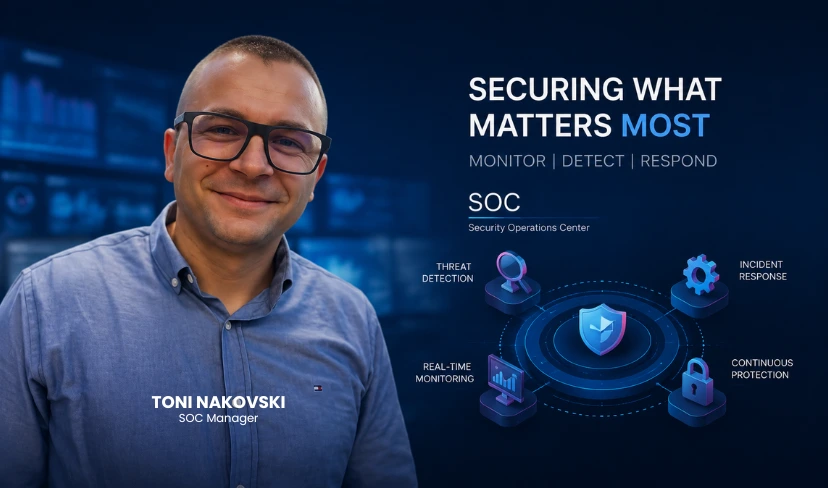
“Eight years working together, and recently, for the first time, our SOC Manager Toni Nakovski shook a client’s hand instead of just hearing their voice on a call.”
It sounds like a small thing. But in managed cybersecurity, a relationship can run for years without ever putting two people in the same room. So when Toni set off earlier this summer on what he called his road trip to the clients, visiting our managed SOC accounts across sectors, it wasn’t a courtesy gesture. It was the kind of in-person check-in that most IT leaders never actually get from a managed SOC provider.
Eight Years Remote. One Handshake.
The visit that stood out most was to IQPC, a client we’ve worked with for eight years. That whole relationship had been built through monthly reviews, Teams calls, and incident response over the phone and chat. This was the first time it became face-to-face.
Each stop followed the same shape as our standard monthly security review: performance, incidents, and what more we can do together. But something changes when that conversation happens across a table. The trust was already there from years of remote delivery. Sitting down together lets it go further.
Several of the visits ran long. A few ended in lunch or drinks with the IT team. Not because it was planned. Just because there was enough goodwill that nobody wanted to wrap up and leave.
“The trust was already there from years of remote delivery. Meeting in person lets the relationship go deeper.”
Why Face-to-Face Still Matters in Managed Security
Most managed SOC relationships are built almost entirely on remote delivery. That is not a criticism. It works, and for a lot of organisations it works well. But there is a ceiling to what you can achieve when two teams only ever interact through a screen and a ticketing system.
When you meet in person, the conversation changes. IT leaders ask the questions they have been sitting on. The security team picks up context about how the client’s environment actually runs day to day, the pressures the team is under, the things that do not make it into a monthly report. Both sides come away with a better understanding of each other than any number of remote calls can give you.
The threat landscape has shifted a lot in the past few years. Attacks are faster, more targeted, and harder to predict. That makes the relationship between an organisation and its security partner more important than ever. Face-to-face visits are one of the most straightforward ways to strengthen it.
Is Your Managed SOC Provider as Close as They Should Be?
Transputec’s managed SOC clients have direct access to the team protecting them, by phone, Teams, or WhatsApp. Not a ticketing queue. Find out what a genuinely close security partnership looks like.
Get a Strategic ConsultationWhat to Look for in a Managed SOC Partner
The technology that underpins most managed SOC services has become fairly consistent across providers. SIEMs, EDR platforms, threat intelligence feeds: most credible providers are working with similar tools. What actually separates a good SOC partner from a great one is the people and how reachable they are when something goes wrong.
Before signing with any managed SOC provider, it is worth asking a few direct questions. Do clients have direct access to the analysts watching their environment, or does everything go through a helpdesk? How does escalation actually work, and who makes the call? How often does the team engage with clients beyond the scheduled reviews?
And it is worth asking when they last visited a client in person. It might sound like an unusual question, but a security partner who never shows up in the same room as their clients is missing something important. The best partnerships are built on communication, consistency, and the occasional face-to-face that keeps the relationship grounded in reality.
“The best partnerships are built on communication, consistency, and the occasional face-to-face that keeps the relationship grounded in reality.”
How Transputec Structures Its Client Security Reviews
Every Transputec managed SOC client gets a monthly security review as standard. These are not tick-box exercises. They cover threat detections and how they were handled, any environment changes that affect the client’s risk profile, relevant threat intelligence for their sector, and a forward look at where additional protection might make sense.
Clients do not go through a ticketing queue to reach us. They have direct access to the team protecting them via phone, Teams, or WhatsApp. So if something looks off at 11pm on a Tuesday, they are not raising a ticket and waiting. They are calling someone who already knows their environment and can act straight away.
Toni’s road trip this summer added something that remote delivery on its own cannot replicate. Not just a check-in on systems and incidents, but a chance to understand the people behind the environment. The pressures they are under. The things they worry about that never quite make it onto a review agenda. That kind of understanding takes a conversation in person.
A Final Thought
If your current security provider has never visited you in person, it is worth thinking about what that means for the relationship. Not every provider will. But the ones who do tend to understand their clients better, respond faster, and stay longer.
Our clients know who to call and they know that person knows them. That is not something that happens by accident. It is something we work at.
Book a Free Strategy Call with Our SOC Team
Speak directly with Transputec’s SOC team. No sales queue, no generic pitch. A 15-minute conversation with the people who would actually be protecting your environment. Get in touch today to arrange your call.
Related reading: Managed IT Services · Cyber Security Services · Armadillo Cyber Resilience
Conclusion
Choosing a managed SOC provider is rarely just about the technology. The tools are often similar across providers. What differs is how reachable the team is, how well they understand your environment, and whether the relationship ever extends beyond a ticketing queue.
Toni’s visits this summer made that point clearly. Eight years of remote delivery had already built real trust with clients like IQPC. Sitting down in person let those relationships go further.
If you are evaluating your current security arrangements or looking for a provider who shows up in more ways than one, Transputec’s SOC team is ready to talk. Contact us to start the conversation.
FAQs
How often should IT leaders meet their managed SOC provider in person?
There is no fixed rule, but an annual or biannual in-person check-in alongside regular remote reviews makes a real difference. It helps deepen trust, surfaces concerns that do not tend to come up on calls, and gives both sides better context on how the environment actually operates.
What does a managed SOC service actually include?
A managed Security Operations Centre provides continuous monitoring, threat detection, and incident response for your IT environment. At Transputec that includes regular security reviews, direct access to the team, and rapid response to potential incidents rather than a ticketing queue. Learn more on our Cyber Security Services page.
What should I ask a managed SOC provider before signing?
Ask how clients reach the team when something goes wrong, how escalation works, how often they review and report, and when they last visited a client in person. The quality of the relationship matters as much as the quality of the technology. See our Managed IT Services page for more on how Transputec works.
How can I contact Transputec's SOC team?
You can reach our SOC team directly via phone, Microsoft Teams, or WhatsApp. Not through a ticketing queue. If something needs attention quickly, you will get through to someone who knows your environment straight away. Contact us here to get started.
Why does the relationship with your managed SOC provider matter?
The relationship determines how quickly a provider responds, how well they understand your environment, and how proactively they flag risks. A provider who only interacts through a ticketing system will always have a shallower understanding of your organisation than one who engages directly and visits in person. That difference shows when an incident happens.