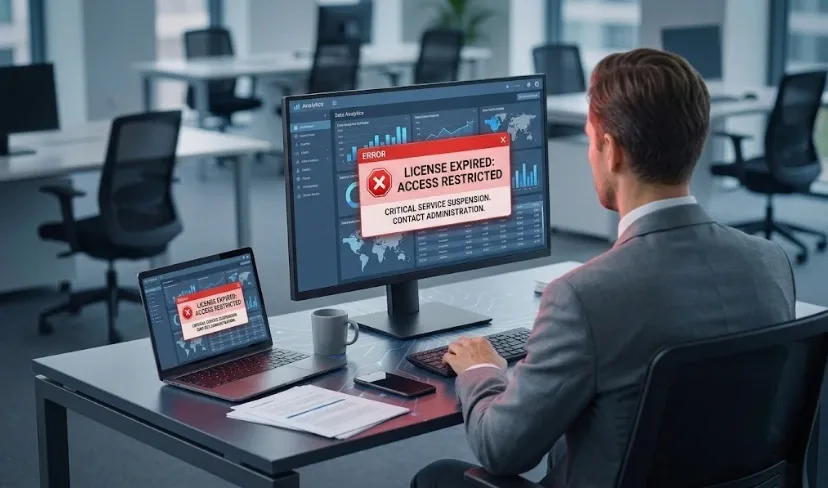
You meant to deal with it last month. The renewal reminder came and went, the date passed quietly, and now a vendor email is sitting in your inbox that you really do not want to open. A missed software renewal deadline is one of those IT problems that appears minor at first glance, until you see what it actually costs.
What happens when you miss a software renewal deadline? The short answer: you pay more, lose your negotiating position, and may find yourself in breach of your licence agreement while still running the software. The longer answer involves penalty clauses, auto-renewal lock-ins, security vulnerabilities, and the very real risk of a vendor compliance audit arriving at the worst possible moment.
This guide sets out the real financial and operational costs that follow a missed software renewal deadline, the specific risks created by vendors including VMware and Microsoft, and what IT and procurement leaders can do to bring renewal tracking under control. Renewals sit inside a wider buying cycle, covered in our guide to IT procurement solutions.
The Real Cost of a Missed Software Renewal Deadline
Research from Zylo’s 2025 SaaS Management Index found that enterprises waste an average of $21 million annually on mismanaged SaaS licences. A significant share of that waste traces directly to missed software renewal deadlines, either through auto-renewals that were not cancelled in time, or through penalty charges triggered by late renewals.
Across enterprise contracts, organisations lose an average of $2.3 million annually on unwanted auto-renewals. A further 88% of businesses report struggling with renewal management, and more than four in ten organisations have no one actively tracking SaaS usage and entitlements.
The cost of a missed software renewal deadline extends well beyond the invoice itself. Here is what most organisations fail to account for until it is too late:
- Penalty charges: Some vendors apply explicit late renewal penalties. VMware, under Broadcom’s ownership, charges a 20% premium on contracts renewed after the anniversary date. On a £500,000 contract, that is an unbudgeted £100,000.
- Auto-renewal lock-in: Miss a cancellation window and you may be locked into another full contract term, often at a higher price than you would have negotiated.
- Premium monthly billing: Microsoft’s NCE framework has removed the grace period for lapsed subscriptions. Licences not renewed or cancelled at term end move into an Extended Service Term, billed at a premium monthly rate above the annual cost.
- Compliance audit exposure: Vendors that detect a lapse in renewal often initiate licence compliance audits, adding legal and administrative cost to the financial penalty.
- Security exposure: An expired licence means expired support. Running software without active maintenance or security patches leaves your systems open to vulnerabilities that vendors will no longer address.
What Actually Counts as a Missed Renewal?
Most IT teams focus on the renewal date itself. The critical date is the notice period deadline, which falls 30, 60, or 90 days before the renewal depending on the contract. Miss the notice window and you lose the right to cancel or renegotiate, regardless of when the invoice arrives.
A contract renewing on 1 October with a 60-day notice period requires action by 2 August. By the time the renewal date arrives, the commercial decision has already been made for you. IT contract renewal management that tracks only the renewal date, rather than the notice deadline, will consistently arrive too late.
Is Your Software Renewal Calendar Costing You?
Transputec works with UK IT and procurement teams to identify renewal risks, review vendor contract terms, and build proactive vendor renewal tracking so a missed software renewal deadline never becomes an expensive problem.
Get a Strategic ConsultationThe VMware Renewal Penalty: A Real-World Warning
When Broadcom acquired VMware in late 2023, it restructured the entire licensing model. One of the changes that received less coverage at the time was the introduction of a formal renewal deadline penalty. Customers who do not renew their VMware subscription licences by their anniversary date are charged an additional 20% on the first year of the renewed contract.
On a £2 million annual VMware contract, that penalty amounts to £400,000 before the new term even begins. It applies regardless of the reason for the delay. Organisations that missed a VMware renewal deadline due to budget approval cycles, team changes, or simply losing track of the date have faced this charge with little recourse.
This is not a theoretical risk. Reporting on Broadcom’s VMware renewal policies confirmed that late renewal penalties are now a standard feature of VMware contracts, alongside minimum core purchase requirements that significantly increased baseline spend for many customers. For organisations still on VMware infrastructure, vendor renewal tracking is no longer an administrative convenience: it is a financial control.
Microsoft NCE and the End of the Grace Period
Microsoft’s New Commerce Experience (NCE) framework has changed the consequences of a missed software renewal deadline for any organisation running Microsoft 365 or Azure subscriptions through the CSP channel.
Previously, Microsoft allowed a grace period after a subscription lapsed, during which services continued while renewal was processed. That grace period is being removed. Under the updated NCE rules, subscriptions that reach their end of term without a clear renewal instruction either convert automatically into an Extended Service Term (EST) or cease, depending on how the partner has configured the subscription.
The Extended Service Term continues service availability, but at a monthly billing rate that carries a premium above the equivalent annual cost. Organisations that miss the deadline and roll into EST are paying more per month than they would have paid per month under an annual commitment, with no corresponding benefit.
There is also a 7-day renewal adjustment window within NCE that, if missed, can lock an organisation into a new annual term they had not intended to accept. IT contract renewal management for Microsoft subscriptions needs to account for this window, not just the contract end date. Transputec’s managed IT services include licence lifecycle oversight for clients who want this visibility without building it internally.
How Auto-Renewal Clauses Trap Organisations
Software auto-renewal costs are one of the most frequently overlooked line items in an IT budget. Most enterprise software contracts include an auto-renewal clause that renews the agreement for another full term unless written cancellation notice is provided within a specified window, typically 30 to 90 days before the renewal date.
The problem is that the notice window is buried in the contract and rarely surfaces in the day-to-day calendar of the person responsible for IT procurement. A contract signed three years ago by someone who has since left the organisation may auto-renew indefinitely without anyone realising until finance questions the invoice.
Research consistently finds that the average company with 200 to 500 employees manages over 100 separate SaaS tools, each with its own renewal date, pricing tier, and notice period. Without a dedicated approach to vendor renewal tracking, missing at least one deadline in any given year is practically inevitable. The question is which one, and how much it costs when it happens.
The UK’s Digital Markets, Competition and Consumers Act 2024 introduced new protections for subscription auto-renewals in consumer contexts. For business-to-business software contracts, the commercial terms remain governed by the contract itself, with no equivalent automatic protection against auto-renewal traps.
Compliance and Legal Risk After a Lapsed Licence
A missed software renewal deadline does more than create a financial liability. It also creates a compliance gap that vendors are increasingly alert to.
When a software licence lapses and the organisation continues to use the product, it is technically operating outside the terms of the licence agreement. Major software vendors monitor usage data and cross-reference it against active licences. When they identify a gap, they frequently respond with a compliance audit.
Compliance audits carry costs that go well beyond any back-licence or penalty fee. They consume significant internal IT and legal resource, require documentation that many organisations struggle to produce quickly, and often surface additional discrepancies that compound the original problem.
From a UK regulatory perspective, running software without valid licence coverage also creates problems under UK GDPR. The ICO’s guidance on technical and organisational measures requires that businesses take appropriate steps to secure the personal data they process. Running unpatched, unsupported software that has lapsed past its renewal point weakens that position considerably. If a data breach occurs on systems running expired software, the lapsed licence status is likely to be a relevant factor in any regulatory investigation.
For a practical starting point on understanding your current licence position, see Transputec’s guide on how to audit your IT software licences.
How to Track IT Software Renewal Dates Effectively
Knowing how to track IT software renewal dates is the foundation of avoiding these costs. The approach does not need to be complex, but it does need to be systematic and owned by a named person.
The core elements of effective IT contract renewal management are:
- A centralised renewal register. Every active software contract, SaaS subscription, and annual maintenance agreement should be recorded in one place, with the contract end date, the notice period deadline, and the responsible owner clearly identified.
- Alerts set to the notice deadline, not the renewal date. The notice deadline is what matters commercially. Set alerts at 90, 60, and 30 days before the notice deadline for any contract worth more than a defined threshold.
- Usage data reviewed before renewal. Every renewal conversation with a vendor should be informed by actual usage data: who is using the software, how often, and which features. This is the basis for right-sizing the contract rather than automatically renewing at the same seat count.
- Budget cycle alignment. Renewal decisions that require budget approval should be flagged at least 90 days in advance to allow time for internal sign-off before the notice deadline passes.
- Ownership continuity. Software contracts should not be owned solely by the person who signed them. When staff move roles or leave, contract ownership should transfer explicitly to a named successor.
Transputec’s IT procurement services include contract lifecycle support as part of the managed procurement offering, covering vendor renewal tracking, vendor engagement, and licence right-sizing ahead of each renewal cycle.
How to Avoid Auto-Renewal Charges on Software
Auto-renewal clauses are written to protect vendors, not customers. Once you understand how they work, avoiding them is straightforward, but it requires discipline and process.
The following five-point approach covers how to avoid auto-renewal charges on software across your estate:
- Read the auto-renewal clause at contract signature. Every contract with an auto-renewal clause should be flagged at the point of signing. Note the notice period, the notice method required (email, written letter, or portal cancellation), and any change-of-form requirements. Many organisations miss renewals because the required cancellation method differs from how they normally communicate with the vendor.
- Negotiate longer notice periods when signing. A 30-day notice window is a short runway for a multi-year contract. Where possible, negotiate 90 days. Some vendors will agree if asked, particularly at initial signing or renewal renegotiation.
- Assign a named owner to every contract above a defined threshold. Contracts without a named owner are the ones that auto-renew unchallenged. Set a monetary threshold (for example, any contract worth more than £5,000 annually) and ensure every contract above it has a named person responsible for renewal decisions.
- Review usage before every renewal, not just at the point of renewal. Usage data collected 6 months before the notice deadline gives you leverage in negotiations. If utilisation is low, you have evidence to right-size. If it is high, you can justify an upgrade on terms that suit you rather than the vendor’s standard pricing.
- Include renewal decisions in your annual budget cycle. Any renewal requiring board or finance approval should enter the budget process at least 90 days before the notice deadline. Late budget conversations are one of the most common reasons organisations miss their window to exit or renegotiate.
Managing software auto-renewal costs across a large estate is complex without the right systems and supplier relationships in place. Transputec’s procurement team works with clients to audit existing contracts, identify upcoming renewal windows, and engage vendors on more favourable terms before the notice deadline passes.
Conclusion
A missed software renewal deadline rarely feels significant until the invoice arrives, the audit letter lands, or the vendor activates the extended service term at premium rates. By that point, the options are narrow and the costs are fixed.
The organisations that manage this well share one thing in common: they treat renewal management as a commercial discipline, not an administrative afterthought. They know their notice deadlines, not just their renewal dates. They review usage data before every renewal, they assign ownership, and they engage vendors from a position of preparation rather than urgency.
The costs of getting this wrong, whether a renewal deadline penalty, an unwanted auto-renewal, a compliance exposure, or a lapsed licence, are avoidable. The systems and discipline required are well within reach for any organisation that chooses to implement them.
Transputec works with IT leaders across the UK to build contract lifecycle processes, audit existing software estates, and manage vendor relationships through every renewal cycle. If your renewal management is reactive rather than proactive, we can help you change that.
FAQs
What happens if you miss a software renewal deadline?
Missing a software renewal deadline can trigger several different consequences depending on the vendor and contract type. The vendor may activate an auto-renewal at the existing price, locking you into another full term without negotiation. Some vendors, such as Broadcom for VMware products, apply a renewal deadline penalty of up to 20% on top of standard renewal pricing for late renewals. With Microsoft’s NCE licensing model, missing the renewal window removes the option to cancel at the annual break point, and you may be placed on an Extended Service Term at higher monthly rates. In some cases, the licence lapses entirely, putting you at risk of a compliance audit. The impact ranges from avoidable cost increases to potential legal and regulatory exposure.
What is a renewal deadline penalty and which vendors apply one?
A renewal deadline penalty is a surcharge applied by a vendor when a customer fails to renew a contract before the notice deadline. The most widely cited example is Broadcom’s VMware licensing model: late renewals attract a penalty of up to 20% on top of standard renewal pricing, in addition to any core count changes Broadcom may require. Broadcom is not alone. Other enterprise software vendors apply lapsed-licence fees, reinstatement charges, or require a new-business quote process for customers who miss their renewal window. The specific penalty structure varies by vendor and contract type, but the common thread is that late renewal is always more expensive than on-time renewal.
How do you track IT software renewal dates across a large estate?
The most reliable approach to tracking IT software renewal dates is a centralised renewal register that records every active contract, the contract end date, the notice period deadline (not just the renewal date), and the named owner responsible for the decision. Alerts should be set at 90, 60, and 30 days before the notice deadline for every contract above a defined value threshold. For larger estates, Software Asset Management (SAM) tools such as Snow Software, Flexera, or Microsoft VISO can automate renewal date tracking and link contract data to actual usage. The key discipline is treating the notice deadline as the critical date, not the renewal date, since acting after the notice deadline has already passed leaves you with limited options.
How can you avoid auto-renewal charges on software?
The most effective way to avoid auto-renewal charges on software is to focus on the notice deadline rather than the renewal date. Read every auto-renewal clause at contract signature, note the required notice method (which may differ from how you normally contact the vendor), and set calendar alerts at least 90 days before the notice deadline. Assign a named owner to every contract above a defined value threshold so that responsibility is clear when staff change roles. Review usage data before every renewal: if utilisation is low, you have grounds to reduce the licence count or exit the contract entirely. If you are renegotiating, use the period before the notice deadline as leverage, since vendors are most responsive when you still have the option to walk away.
What are the compliance risks of running software after a licence lapses?
Running software after a licence lapses creates two categories of compliance risk. The first is vendor audit risk: most enterprise software agreements include audit rights, and a lapsed licence is one of the clearest triggers for a vendor to initiate an audit. The financial exposure in an audit includes back-licensing fees, penalties, and legal costs. The second is regulatory risk under UK GDPR: if a lapsed licence means a software product is no longer receiving security patches or updates, and that product processes personal data, the organisation may be in breach of its obligations under Article 32 of the UK GDPR, which requires appropriate technical security measures. The Information Commissioner’s Office can issue fines and enforcement notices for failure to maintain adequate security controls. A lapsed licence is not simply an inconvenience; it is a potential regulatory liability.
This article was drafted with AI assistance and reviewed by the Transputec team. Featured image: AI-generated.