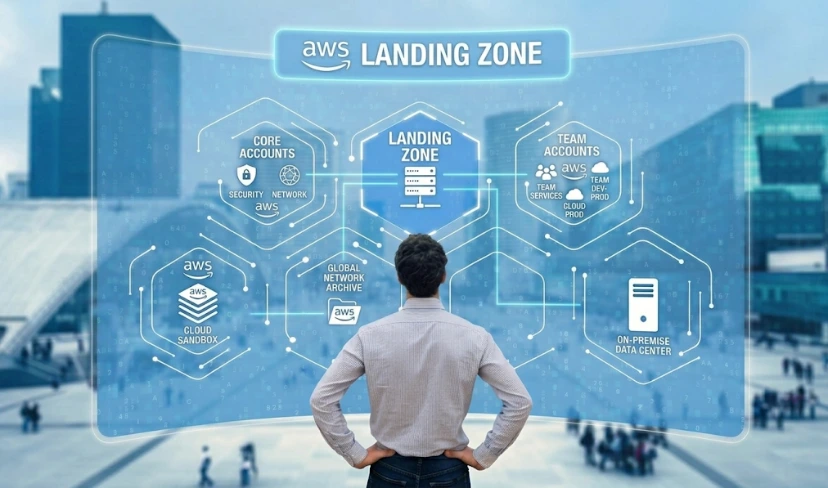
The most expensive mistakes in enterprise cloud are made on day one, before a single workload moves. A quick account here, a permissive policy there, no clear network design, and within a year you have a sprawl that is hard to secure, hard to audit and hard to bill accurately. The fix is to start with a proper foundation: AWS Landing Zones.
AWS Landing Zones are a pre-configured, secure, multi-account AWS environment built to best practice from the start: identity, networking, security guardrails, logging and governance, all in place before your first workload lands. For a UK enterprise, that is the difference between scaling on solid ground and building on sand.
This guide is for the people who own that foundation: CIOs, enterprise architects and heads of cloud at UK organisations. If you have been asking how to set up an AWS landing zone for enterprise UK without getting it wrong, this explains what good looks like and how the right partner gets you there faster.
Get the foundation right and everything after it is easier, cheaper and safer. Get it wrong and you spend the next three years retrofitting controls. AWS Landing Zones are how serious UK enterprises avoid that.
What are AWS Landing Zones?
AWS Landing Zones give you a secure cloud foundation enterprise teams can build on without reinventing the basics. Most are built with AWS Control Tower, a managed service that automates the setup and ongoing governance of a multi-account environment. A typical landing zone includes:
- A multi-account structure that separates production, development, security and logging.
- Centralised identity and access through IAM Identity Center.
- A network design with VPCs, segmentation and controlled connectivity.
- Security guardrails, both preventive and detective, applied across every account.
- Centralised logging and audit trails for security and compliance.
The multi-account model is the part people underestimate. Separate accounts give you clean blast-radius isolation, simpler billing per team or workload, and the ability to apply different controls where the risk is higher. Trying to achieve the same separation inside one or two accounts is fragile and hard to audit, which is why the landing-zone pattern has become the enterprise default.
Transputec designs and operates AWS landing zones for UK organisations as part of its AWS managed services, with UK-based architects, ISO 27001 governance and data kept in the London region. The result is a foundation that is consistent, governed and ready to scale.
Why a secure cloud foundation matters from day one
Controls are far cheaper to build in than to bolt on. Retrofitting identity, network segmentation and guardrails onto a live estate means change freezes, risk and rework, often across dozens of accounts at once. AWS Landing Zones put those controls in place before there is anything to break, so security and governance are the default rather than a later project.
For UK enterprises there is a compliance dimension too. A landing zone designed around the London region keeps data and processing in the UK, which supports UK GDPR and sector obligations, and aligning the design with the AWS Well-Architected Framework and NCSC cloud security guidance keeps it defensible to auditors. Strong cloud security starts here, not after the first incident.
There is a cost and speed argument as well. When every new account inherits the same secure baseline, teams can self-serve a compliant environment in hours instead of waiting weeks for a manual build, and finance gets clean per-account cost data from the start. AWS Landing Zones turn governance from a bottleneck into an enabler, which is exactly what a fast-moving enterprise needs.
Starting or re-platforming on AWS?
Talk to a UK-based AWS architect about building a secure, well-governed landing zone before you migrate, not after the workloads are already live.
Get a Strategic ConsultationHow to set up an AWS landing zone for enterprise UK
Here is how AWS Landing Zones come together in practice, and what a good partner does at each step to keep the foundation secure and scalable.
1. Design the account structure
Start with how accounts map to your organisation: separate production from development, ring-fence security and logging, and group workloads by business unit or risk. A clear structure now prevents painful re-organisation later, when moving an account between organisational units can mean reworking policies and network routes across the estate. Spending a day on the structure up front saves weeks down the line.
2. Deploy the baseline with AWS Control Tower
AWS Control Tower stands up the core landing zone: the account factory, baseline guardrails, centralised logging and identity. Treat this as your AWS Control Tower setup guide UK starting point, then tailor it to your sector and risk appetite rather than accepting every default.
3. Set guardrails and security baselines
Apply preventive guardrails that stop risky actions and detective ones that flag drift, mapped to recognised standards. For a UK enterprise, these guardrails double as compliance controls, so governance and security reinforce each other from the start.
4. Wire up networking and connectivity
Design VPCs, segmentation and connectivity to on-premise or other regions deliberately, with a landing zone pattern that every new account inherits. Get the address ranges and routing right once, centrally, so teams are not left untangling overlapping networks later. Consistent networking is what keeps a growing estate manageable and a future cloud migration straightforward.
5. Hand over with governance and FinOps
A landing zone is only useful if it stays healthy. Ongoing cloud management, cost controls and tagging keep it that way, and a FinOps cadence keeps spend predictable. Transputec reports median AWS spend reductions of around 32% after a FinOps review, with a worked example in our AWS cost optimisation case study.
Why UK enterprises build landing zones with AWS partners
You can build a landing zone in-house, but most UK enterprises choose to do it with AWS partners for speed and certainty. The right partner has built dozens of these before and knows where the defaults fall short for a regulated or large estate. The signals that matter are AWS Advanced Tier status, UK-based certified architects, ISO 27001 and Cyber Essentials Plus, UK data residency and a documented exit path so you are never locked in.
Experience also shows up in the handover. A capable partner does not just deploy AWS Landing Zones and walk away, it gives you a governed foundation, clear documentation and a team that knows your estate. It will also train your people, so your engineers can operate the landing zone with confidence rather than depending on the partner for every change. Transputec’s partner overview and certifications set out what the right partner brings to an enterprise build.
Conclusion
For a UK enterprise, the cloud foundation you lay on day one shapes the next several years of cost, security and agility. A well-designed landing zone puts identity, networking, guardrails and governance in place before your first workload, so scaling is safe by default rather than a series of expensive, disruptive retrofits down the line.
That is why AWS Landing Zones have become the standard starting point for serious enterprise builds. Done with an experienced partner, you get a secure, governed, UK-resident foundation in weeks, not a multi-year clean-up. If you want to know what a strong landing zone would look like for your organisation, our team is ready to help.
FAQs
What is an AWS Landing Zone?
An AWS Landing Zone is a pre-configured, secure, multi-account AWS environment with identity, networking, security guardrails, logging and governance set up to best practice before workloads are deployed. Transputec designs and runs AWS landing zones for UK organisations with ISO 27001 governance.
What is AWS Control Tower?
AWS Control Tower is a managed AWS service that automates the setup and ongoing governance of a landing zone: it creates accounts through an account factory, applies baseline guardrails, and centralises logging and identity. It is the most common way to build and maintain an enterprise landing zone.
How long does it take to build an AWS landing zone?
For most UK enterprises, a production-ready landing zone takes a few weeks rather than months, depending on the number of accounts, network complexity and compliance needs. Building it before a cloud migration means workloads land on a secure foundation from the first day.
Do AWS Landing Zones keep data in the UK?
Yes, when designed for it. AWS operates a London region (eu-west-2), so a landing zone built around it keeps data and processing in the UK, which supports UK GDPR and sector compliance. A good design documents residency and aligns with NCSC cloud security guidance.
Should we build our AWS landing zone with an AWS partner?
For an enterprise estate, yes. Experienced AWS partners build landing zones faster and avoid the costly mistakes of a first attempt. Reviewing a partner’s certifications is the quickest way to confirm they can deliver a secure, compliant foundation.