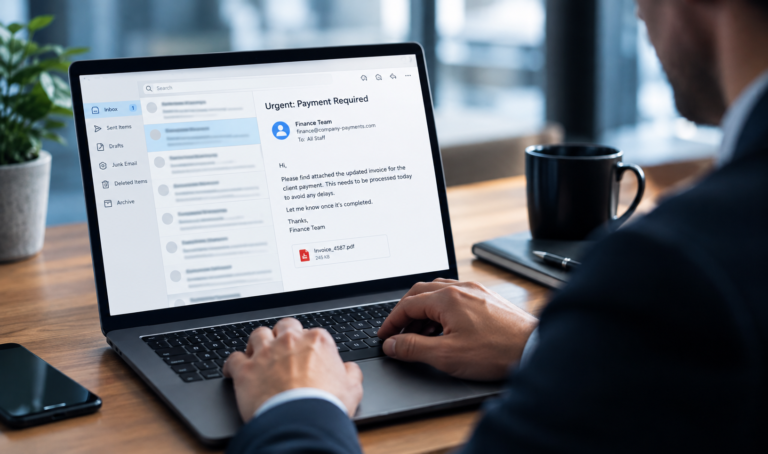
It’s 8:47am. Your inbox already has forty-one unread emails, three of them from a client who needs an answer before a 9am call you haven’t prepped for. Somewhere in your calendar sits a Teams meeting from yesterday afternoon whose recap you never got round to reading. This is the exact gap Microsoft Copilot in Outlook and Teams is built to close: not a futuristic assistant, but a practical tool that reads the backlog for you, drafts the reply, and tells you what actually happened in the meeting you missed.
What Is Microsoft Copilot in Outlook and Teams?
Microsoft Copilot in Outlook and Teams is Microsoft’s AI assistant built into the two applications most office workers live in daily. It works quietly inside your existing inbox and calendar, rather than as a separate app you have to learn.
- In Outlook: it summarises long email threads, drafts and rewrites replies, and helps organise a cluttered inbox using plain-language rules.
- In Teams: it produces meeting recaps, actionable summaries and highlights of what was decided, so nobody has to sit through a recording to catch up.
- Across both: it draws only on content already in your mailbox, calendar and meetings, not external data.
What Actually Changes Once You Turn Copilot On?
The honest answer is less than the marketing suggests, and more than the sceptics expect. Copilot will not rewrite your job description or replace judgement calls, but it does remove a specific category of admin: catching up on missed context, writing the first draft of a routine reply, turning an hour-long meeting into three readable paragraphs. For teams already using Microsoft 365, the tool is already sitting inside the apps they open every day, with no separate software to install or learn from scratch. What follows is a practical look at what it actually does day to day in Outlook and Teams, where it earns its keep, where it still needs a human to check its work, and what a proper rollout looks like once the initial curiosity wears off.
Ready to Put Microsoft Copilot in Outlook and Teams to Work?
See exactly how Copilot fits your existing Outlook and Teams setup, licensing and rollout plan before you commit budget.
Get a Strategic ConsultationWhat Does Microsoft Copilot Do in Outlook Day to Day?
Day to day, Copilot in Outlook reads your unread emails, drafts replies in your voice, and reorganises your inbox using instructions you type in plain English rather than mail rules built through a menu.
- Thread summaries: select Summarize by Copilot on a long thread and it scans every message for the key points, often with numbered references back to the original messages so you can check the source.
- Reply drafting: ask it to draft a reply to a supplier chasing a late invoice, and Copilot produces a first draft you can edit rather than a blank box staring back at you.
- Tone checks: it can flag tone before you hit send, catching a reply that reads more abrupt than intended.
- Inbox rules in plain English: describe a rule, such as moving newsletters into a folder, instead of building it manually through a menu.
None of this replaces judgement. It removes the fifteen minutes most people spend reading three screens of back-and-forth before writing a two-line reply.
Is the Copilot for Outlook Review Worth the Hype?
Most honest reviews land in the same place: Copilot for Outlook is genuinely useful for triage and drafting, and genuinely unreliable if you expect it to understand nuance or company-specific context without guidance. It is strong at summarising long threads accurately, drafting competent first-pass replies, and applying inbox rules described in plain language. It is weaker at picking up on relationship history, sarcasm, or the unwritten politics of who needs to be copied on what.
The practical verdict from most IT teams running a Copilot for Outlook review inside a live tenant is that it saves genuine time on routine correspondence, and needs a human check on anything client-facing or contractually sensitive. Microsoft’s own guidance on summarising email threads confirms the summary always links back to source messages, which is worth checking rather than trusting blindly.
What Does Copilot Do in Teams Meetings?
In a Teams meeting, Copilot follows the transcript in real time and can answer questions about what has already been said, list the decisions made so far, or summarise a tangent you stepped away from.
- Live Q&A: ask Copilot mid-meeting what was decided or who owns an action, without interrupting the conversation.
- Intelligent recap: after the meeting ends, it breaks the recording into a readable summary organised by topic.
- Action items: it flags tasks with the person responsible, so nothing depends on someone remembering to write it down.
- Jump-to-moment: lets you jump straight to the point in the recording where a decision was made, rather than scrubbing through forty minutes.
This is the core of what Copilot in Microsoft Teams does for anyone who joins five minutes late or misses a meeting entirely: it turns a recording nobody has time to watch into a document somebody can actually read. Microsoft’s documentation on intelligent recap confirms this requires a Teams Premium or Microsoft 365 Copilot licence to unlock.
How Does Copilot Summarise Meetings in Teams When You've Missed Them?
Copilot summarises a missed Teams meeting by pulling the recorded transcript into a structured recap rather than leaving you to replay the whole call.
- Key discussion points organised by topic, not just in chronological transcript order.
- Agreed actions with named owners, so accountability does not get lost between meetings.
- A searchable transcript you can scan for your name instead of watching the recording back.
- Speaker summary and executive report formats, added in recent updates, for different levels of detail depending on who is reading it.
For distributed or hybrid teams, this recap is often more useful than attending live, because it strips out the small talk and leaves the decisions. It does still need someone who was present to confirm nothing important was summarised inaccurately, particularly on anything with numbers or dates attached.
What Does the Microsoft Copilot Outlook Email Draft Feature Actually Produce?
The Microsoft Copilot Outlook email draft feature produces a complete first draft based on a short instruction, for example “reply and confirm we can meet the deadline but flag the extra cost”, rather than a set of suggested phrases you have to stitch together yourself. You can ask it to make a draft shorter, more formal, or more direct, and it rewrites the same draft rather than starting again from nothing.
Teams that have rolled this out through a proper Copilot deployment programme tend to see the biggest gains on repetitive correspondence: status updates, chasing emails, scheduling replies. It is less convincing on the first email in a new negotiation, where tone and precedent matter more than speed, and where a human still needs to own the wording.
Is Microsoft Copilot in Teams Worth It for Meetings?
For most organisations already paying for Microsoft 365, yes, Copilot in Microsoft Teams is worth it for meetings specifically, because meeting recap and live summarisation solve a problem every hybrid team has: too many meetings and not enough time to properly review them. The return is clearest for anyone who regularly misses meetings, joins late, or manages people across time zones, since the recap replaces an hour of video with a five-minute read.
It is a harder sell if your meetings are already short and well-run, where the overhead of an extra licence outweighs the time saved. The wider question of whether Microsoft Copilot in Outlook and Teams is worth it across a whole organisation, not just for meetings, usually comes down to licence cost against how much of the working day is spent in email and Teams calls, which is exactly what a proper Copilot-readiness assessment is designed to work out before you commit budget.
Conclusion
Microsoft Copilot in Outlook and Teams does not change what your job is. It changes how much of your working day is spent reading, summarising and drafting things a computer can now do a reasonable first pass at. The email backlog still needs a decision made on it, and the meeting recap still needs someone who understands the business to check it is right, but the admin layer underneath both gets noticeably thinner.
For organisations already on Microsoft 365, the tool is not a future investment, it is already inside the licence most people are paying for. The gap most businesses have is not access to Copilot, it is a rollout that never got past a handful of enthusiastic early adopters. Transputec helps organisations get Microsoft Copilot in Outlook and Teams working properly across a whole tenant, not just a pilot group, with the licensing, governance and training that turn a feature nobody uses into one that actually changes the working day.
FAQs
What Does Microsoft Copilot in Outlook and Teams Actually Do?
Microsoft Copilot in Outlook and Teams summarises long email threads, drafts and rewrites replies, and produces meeting recaps and action items from Teams calls, all from inside the apps you already use. It works from the content already in your mailbox and meetings rather than external data, which is what makes the output specific to your own inbox and calendar. Transputec’s Copilot for Microsoft 365 service covers deployment and training for organisations rolling it out at scale.
What Is a Microsoft Copilot Email Summary and How Accurate Is It?
A Microsoft Copilot email summary is a short overview Copilot generates at the top of a long thread, pulling out the key points and, in many cases, numbered references back to the original messages. Accuracy is generally strong on factual content such as dates, decisions and requests, but it is worth a quick read of the source thread before acting on anything time-sensitive or contractual.
Does Copilot in Microsoft Teams Work for Voice-Only Calls or Only Video Meetings?
Copilot in Microsoft Teams works for both, provided the meeting is recorded or transcribed and the organisation has the correct licensing enabled. Intelligent recap and live summarisation rely on the transcript rather than the video itself, so a voice-only call with transcription switched on produces the same recap quality as a video meeting.
How Long Does It Take to Roll Out Microsoft Copilot Across Outlook and Teams?
Most organisations can pilot Microsoft Copilot in Outlook and Teams within a few weeks, though a full rollout with governance, training and adoption tracking typically runs six to twelve weeks depending on tenant size. Businesses coming off a trial period often ask the same question covered in Transputec’s guide on what to do after a Microsoft Copilot trial ends: licence, scale, or walk away.
Is Microsoft Copilot in Teams Worth It for Meetings If We Are a Small Business?
It depends on meeting volume more than headcount. A small business running frequent client or project meetings often gets a fast return from recap and summarisation alone, while a small team with few scheduled meetings may see limited benefit. Transputec’s honest look at whether Microsoft 365 Copilot is worth it for small business breaks down the licensing maths in more detail.
This article was drafted with AI assistance and reviewed by the Transputec team. Featured image: AI-generated.