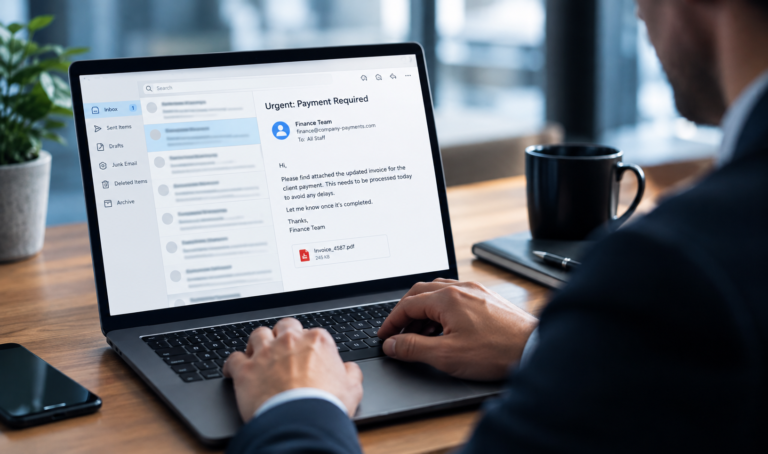
SMEs sit at the top of the list for AI-powered cyberattacks because they often lack the resources to fight back effectively. Attackers use AI to craft personalised phishing emails or scan for vulnerabilities at scale, hitting your business faster than you can respond. In 2026, this means real cash losses, downtime, and lost customers if you ignore it now.
You run a tight ship as COO or CIO. Every hour offline costs revenue. AI-driven attacks amplify small business cyber threats by making them smarter and cheaper for criminals, turning your efficiency into their opportunity.
What Are AI-Powered Cyberattacks?
AI-powered cyberattacks use artificial intelligence to make threats more precise and relentless. Think AI generating fake emails that mimic your suppliers or scanning your network for weak spots in seconds.
These differ from old-school hacks. Traditional attacks were blunt; AI makes them adaptive. Criminals feed public data from your LinkedIn or website into AI tools to create convincing lures tailored to your team.
At Transputec, we see this daily in our Security Operations Centre. AI tools let attackers test millions of phishing variants until one lands, bypassing basic filters your current setup might rely on.
Why Do SMEs Face AI-Driven Attacks?
You target growth, not headlines. But SME’s cybersecurity gaps make you low-hanging fruit. Larger firms have layers of defences; you often run lean with shared passwords or outdated software.
Attackers pick SMEs for quick wins. Your supply chain links to bigger players, so breaching you gives them a backdoor. Plus, 76% of organisations struggle with AI attack speed, and SMEs feel it worst with limited IT staff.
Real example: A logistics SME lost £200k last year to AI-crafted emails posing as invoice updates. Staff clicked because the tone matched their account manager perfectly. Your business could be next.
Ready to Stop AI Cyber Threats?
Transputec identifies vulnerabilities in endpoints, cloud setups, and staff training all within one week. Secure uptime and scale without fear.
Key Risks of AI Cyber Threats to SMEs in 2026
Ignore this, and AI cyber threats to SMEs in 2026 will hit your bottom line hard. Ransomware evolves with AI to encrypt faster and demand more. Phishing success rates climb as AI dodges spam filters.
- Hyper-Realistic Phishing: AI crafts emails or messages mimicking your suppliers or CEO with perfect tone and details from public data like LinkedIn. Your team clicks, granting access to finances or customer records. UK SMEs face 65,000 daily attempts; one slip costs £100k+ in recovery.
- Adaptive Ransomware: AI-driven malware learns from defences, rewriting itself to encrypt files faster and evade scans. Downtime hits weeks, with demands averaging £500k plus data leaks for leverage. SMEs pay the most, as backups often fail due to speed.
- Deepfake Impersonation: Cloned voices or videos trick staff into urgent wire transfers or credential shares. A finance approval goes to fraudsters; we’ve seen £50k losses in hours. Detection lags without AI-matched tools.
- Supply Chain Breaches: Attackers hit your links to bigger clients, using you as the weak entry. One compromise exposes partners, killing contracts worth millions. 2026 sees this spike as SMEs connect more clouds.
- Data Poisoning and Blind Spots: Hackers taint your AI tools’ training data, causing security systems to miss real threats. Public LLMs leak client info to attackers. Compliance fines under GDPR add £17m risk.
What Happens If You Don’t Act on AI-Driven Attacks?
- Financial Drain: Ransomware locks your systems, demanding £500k+ averages for SMEs. Recovery adds £100k in downtime and fines; 43% of UK SMEs faced this last year, wiping quarterly profits while competitors grab your clients.
- Operational Shutdown: Attacks halt email, cloud access, and payments for days or weeks. You lose £9k per minute offline, scrambling with manual workarounds that kill efficiency and delay shipments or services.
- Reputation Collapse: Customer data leaks via phishing expose you to GDPR fines up to £17m. Clients flee after breach headlines; trust rebuilds take years, costing contracts worth millions in lost revenue.
- Supply Chain Fallout: Hackers use your breach as a gateway to bigger partners, blacklisting you from deals. Interconnected clouds amplify this; one weak link ends partnerships and stalls your growth plans.
- Regulatory and Legal Hits: Unpatched vulnerabilities trigger investigations, with average SME breach costs at £31k plus ongoing audits. Non-compliance snowballs into lawsuits from affected customers, diverting focus from core business.
Real-World Scenarios Hitting SMEs
Picture this: Your finance lead gets an AI-generated email from “HMRC” with a tax query link. It looks legit, uses their name, and references a real invoice. Click, and malware spreads.
Or deepfakes: Attackers clone your CEO’s voice for a wire transfer request. Your ops manager approves £50k to a fraudster. These hit SMEs on a weekly basis now.
We at Transputec stopped one last month for a client. Our AI-driven tools flagged the anomaly in seconds, saving their quarter’s cash flow.
Costs and ROI of Ignoring vs Facing These Threats
Basic antivirus won’t cut it. AI-driven attacks evolve mid-strike. You spend £10k-£50k reacting to a breach, plus lost productivity.
Proactive setup costs less: £2k-£5k monthly for managed services, slashing risks by 80%. ROI shows in uptime (99.9%) and zero major incidents.
Transputec clients see 40% efficiency gains. Fixed costs mean no surprise bills, letting you scale without security worries.
Risk | Cost of Breach | Prevention Cost (Monthly) | ROI Timeline |
Phishing | £100k+ (downtime + fines) | £1.5k | 2 months |
Ransomware | £500k (ransom + recovery) | £3k | 1 month |
Supply Chain | Lost contracts (£1m+) | £2k | Immediate |
Protecting SMEs from AI-Powered Cyber Attacks
You need speed and smarts. Start with endpoint protection that uses AI to fight AI. Layer in email filters trained on latest threats.
Train staff quarterly on red flags like odd urgency or profile mismatches. Test with simulations.
Partner for 24/7 coverage. Transputec’s SOC uses XDR for full visibility, automating responses to neutralise threats before damage.
How Can SMEs Spot AI-Driven Phishing?
Watch for perfect grammar in urgent requests and for links that don’t match expected domains (46 words). AI slips on context; hover over links. Use tools scanning for generative patterns, blocking 90% pre-click.
Actionable Framework: 5 Steps to Shield Your SME
Follow this checklist. Each step links to outcomes like cost savings and resilience.
- Audit Your Setup (Week 1): Map endpoints, cloud apps, and remote access. Fix weak passwords and unpatched software. Outcome: Cuts 50% of entry points.
- Deploy AI-Matched Defences (Week 2): Roll out XDR and SOAR tools. Automate threat hunts. Outcome: Response drops to seconds, not days.
- Train and Test Staff (Ongoing): Run phishing sims monthly. Focus on the business impact of clicks. Outcome: Human error falls 60%.
- Monitor 24/7 (Immediate): Outsource to a SOC like Transputec’s. Get alerts on anomalies. Outcome: Sleep easy, zero surprises.
- Please review and adapt quarterly by checking threat feeds and updating rules. Outcome: Stay ahead of 2026 trends, scale securely.
Transputec handles steps 2-5, integrating with your stack for seamless growth. Clients report 30% risk reduction in month one.
Benefits of Transputec's Approach
We focus on your outcomes. Our ThreatSpike partnership delivers AI threat detection without complexity.
You get resilience: 24/7 SOC, rapid response across time zones. Costs stay predictable, freeing the budget for expansion.
Scale with confidence. High-growth startups use us to harden their defences as they grow, avoiding breaches that kill momentum.
Conclusion
AI-powered cyberattacks target SMEs because you offer quick, high-reward hits with fewer barriers. Act now to audit, deploy smart tools, and partner for monitoring, or face downtime and losses in 2026.
Transputec helps SMEs adopt practical, outcome-focused security strategies using AI-driven protection and managed oversight.

Ready to Experience the Transputec Difference?
Contact us today to schedule a consultation with our experts.
FAQs
1. How Do AI-Powered Cyberattacks Work?
AI starts by harvesting data on you from public sources. It then builds hyper-realistic phishing or deepfake calls that fool even trained staff. Tools automate this at low cost, hitting thousands like you daily. Detection lags because AI mimics normal behaviour.
2. Why Are Small Businesses Targeted by AI Cyberattacks?
SMEs hold valuable data but skimp on their defences. Attackers see easy entry via remote workers or cloud misconfigurations. Your customer lists or payment details fetch high prices on dark web markets. Scale matters less when AI lowers its effort.
3. What Makes SMEs Vulnerable to These Threats?
Limited budgets mean patchy tools and no 24/7 monitoring. Hybrid work expands endpoints like laptops and IoT devices, unseen by basic antivirus software. AI exploits this sprawl, probing quietly until it strikes.
4. How can SMEs protect against AI-driven phishing?
Deploy AI-powered email filters and staff training. Transputec integrates Mimecast for real-time scanning, blocking 95% of threats. We simulate attacks to build team resilience, directly tied to fewer incidents and preserved revenue.
5. What are the biggest AI cyber threats to SMEs right now?
Phishing, ransomware, and deepfakes top the list. These evolve fast; 82% of phishing uses AI. Our XDR platform at Transputec automates detection across email, endpoints, and cloud, giving you agility without internal hires.
6. How does Transputec help SMEs build cyber resilience?
We provide end-to-end services: SOC monitoring, vulnerability scans, and compliance audits. Paired with AI tools like Tanium, you get automated fixes and 99.9% uptime. Focus on growth; we handle threats.