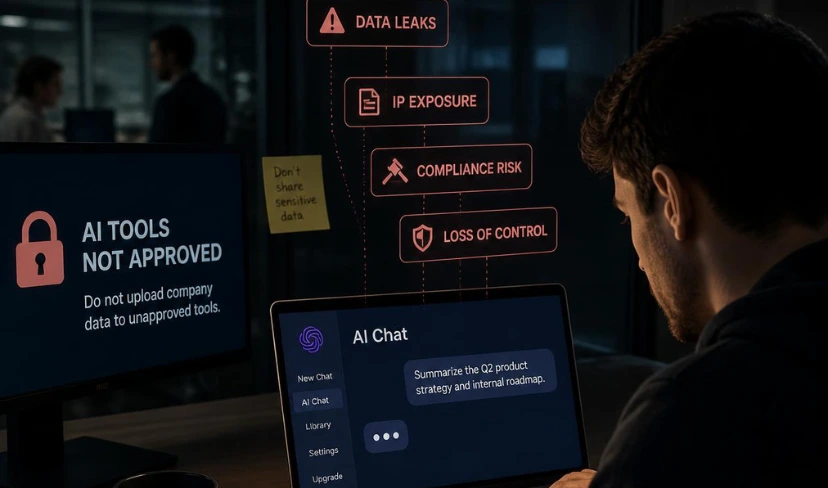
Your employees are almost certainly already using AI tools you have not approved. Not out of carelessness, but because tools like ChatGPT, Google Gemini, and Perplexity are free, powerful, and available on any browser. They help people work faster. And in most organisations, nobody asked permission first.
This is what is Shadow AI in practice: artificial intelligence being used inside your business without the knowledge, oversight, or approval of IT, security, or leadership. It sits beneath the surface of your official technology stack, invisible on dashboards, unaccounted for in risk registers, and entirely outside your data governance policies.
For IT leaders and CISOs in UK businesses, Shadow AI is no longer a theoretical concern. It is happening today, across your finance team, your HR department, your sales function, and your legal team. The question is not whether it exists; it is whether you know about it, and whether you have the controls in place to manage the risk it carries.
What is Shadow AI?
What is Shadow AI? Shadow AI refers to the use of artificial intelligence tools, applications, or capabilities by employees or teams within an organisation without the explicit knowledge or authorisation of IT, security, or management. It is the AI equivalent of shadow IT, where staff use software outside of approved channels.
Common Shadow AI examples include employees using ChatGPT to draft emails or reports, feeding confidential business data into AI summarisation tools, using AI-powered browser extensions not on the approved software list, or connecting corporate systems to third-party AI platforms via unofficial integrations.
The term captures a broad range of behaviours. At one end, it includes someone using a free AI tool to help write a presentation. At the other, it includes a developer integrating an unapproved large language model into a business-critical application with no security review whatsoever. In both cases, the risk to the organisation is real, even if the intention was entirely benign.
Why Employees Use Unauthorised AI Tools at Work
Understanding Shadow AI in the workplace begins with understanding why it happens. The answer is rarely malicious intent. Employees use unauthorised AI tools because those tools make their jobs easier, and because official alternatives are often slower to arrive, harder to access, or simply do not yet exist.
AI tools like ChatGPT, Copilot for personal use, and Gemini have become part of everyday digital life. People use them at home and see no reason not to use them at work. Procurement and IT approval cycles can take months. If someone in your marketing team can produce better content in half the time using a free AI tool, they are not going to wait for the governance committee to reconvene.
Organisations that have not yet defined a clear AI policy create a vacuum. In that vacuum, employees make their own decisions. That is precisely where Shadow AI risks begin to accumulate, quietly and at scale, long before anyone in leadership notices.
Is Shadow AI Already a Risk Inside Your Business?
Transputec helps UK organisations identify Shadow AI exposure and build practical governance frameworks that let your teams use AI safely, without slowing down the work that matters.
Get a Strategic ConsultationShadow AI Risks for Enterprise Companies
Shadow AI risks for businesses are real, measurable, and growing. When employees use unapproved AI tools, several categories of risk open up simultaneously. Each carries its own consequences, and many compound each other.
Data security and leakage. The most immediate risk is data leaving your organisation’s control. When an employee pastes a confidential client contract into a public AI chatbot to get a summary, that data is sent to a third-party server. Depending on the provider’s terms of service, it may be used to train future AI models. Your client never consented to that. Your legal team almost certainly does not know it happened.
Regulatory and compliance exposure. UK businesses operating under UK GDPR, FCA rules, or sector-specific obligations such as NHS data standards have a duty to know where personal and sensitive data is processed. If employees are feeding that data into external AI tools, your organisation may be in breach of its data processing agreements, its ICO obligations, and in some cases its regulatory licence conditions. The ICO’s guidance on AI and data protection is clear that organisations are responsible for data flows to third-party AI tools, whether those flows were authorised or not.
Accuracy and business risk. AI tools produce plausible-sounding output that is not always correct. When employees rely on Shadow AI for research, analysis, or decision-making without appropriate verification, errors can feed directly into business processes. Financial forecasts, legal summaries, HR decisions, and client communications are all areas where AI inaccuracies can cause material harm.
Reputational risk. AI-generated content that carries your brand can reflect poorly on your organisation if it contains inaccuracies, inappropriate language, or intellectual property surfaced from AI training data without proper attribution.
For a broader view of how AI-related threats are evolving in the UK, our blog on LLM API security covers how attackers are now targeting AI integrations directly, adding a further dimension to the Shadow AI security risks picture.
Shadow AI Examples: What It Looks Like in Practice
Shadow AI examples are not always dramatic. They often look mundane, which is precisely why they accumulate without being noticed. Across UK businesses of all sizes, these are among the most common patterns:
- The report writer: A finance analyst uses ChatGPT to summarise quarterly figures and draft board commentary. The data they paste in includes unaudited numbers, client revenue breakdowns, and salary information.
- The support shortcut: A customer service team starts using an AI browser extension to suggest responses to client queries. The extension has access to the browser session and potentially the CRM data visible on screen.
- The developer’s assistant: A software developer uses an unapproved code generation tool to speed up a project. The tool transmits code snippets, including authentication logic and API keys, to a third-party cloud environment.
- The recruiter’s helper: An HR manager uses a personal AI subscription to screen CVs and draft job descriptions. Candidate data, including sensitive personal characteristics, is processed outside any approved HR system.
- The legal shortcut: A contract manager uses a public AI tool to review supplier agreements. Confidential commercial terms are sent to a server with no data processing agreement in place.
In each case, the employee’s intention is simply to work more efficiently. The risk is not their motivation; it is the gap between what they did and what your governance framework says should happen. The NCSC’s AI security guidance highlights that many AI-related risks inside organisations stem from unmanaged third-party tool use rather than external attacks.
How to Manage Shadow AI in Your Organisation
Knowing how to manage Shadow AI starts with accepting that prohibition alone does not work. Banning AI tools without offering alternatives simply drives the behaviour further underground. Effective management requires a three-part approach: visibility, governance, and enablement.
Get visibility first. You cannot manage what you cannot see. Start by auditing which AI tools are actually in use across your organisation. Network monitoring, browser extension audits, and user surveys will surface the most common tools. Endpoint management solutions can identify AI applications running on managed devices. Transputec’s managed IT services include visibility tooling that helps organisations understand their full software footprint, including unauthorised AI adoption.
Establish a clear AI governance framework. Document what is permitted, what is prohibited, and what requires approval before use. An AI register, similar in structure to your existing software register, gives employees a simple reference point. Define which data classifications can and cannot be processed by third-party AI tools. Make the approval pathway fast enough to actually compete with the convenience of simply using a free tool.
Train your people. Most employees engaging in Shadow AI in the workplace do not realise they are taking a risk. A short, practical training module covering what Shadow AI is, what data must not be shared with external AI tools, and how to request approval for new tools will reduce unintentional exposure significantly.
Offer approved alternatives. The most effective way to reduce Shadow AI security risks is to give employees approved tools that meet their needs. If your organisation has Microsoft 365, Microsoft Copilot delivers AI assistance within your existing security boundary. Transputec’s AI consulting services help organisations select, deploy, and govern AI tools that meet both productivity and security requirements.
How to Create a Shadow AI Policy
A Shadow AI policy is a formal document that defines your organisation’s position on unsanctioned AI tool use. It does not need to be long or complex to be effective. The goal is clarity: employees should know exactly what is allowed, what is not, and what to do when they want to use a new AI tool.
A practical Shadow AI policy should cover the following areas:
- Scope: Define what constitutes an AI tool for the purposes of the policy, including generative AI chatbots, AI-powered browser extensions, AI features within third-party SaaS applications, and AI coding assistants.
- Data classification rules: Specify which data categories may never be processed by external AI tools, typically anything classified as confidential, commercially sensitive, personally identifiable, or subject to professional privilege.
- Approved tools list: Maintain a current list of AI tools that have passed your security and procurement review. Update it regularly and make it easy for employees to find.
- Approval process: Define a clear, time-bound pathway for employees to request approval for new AI tools. A process that takes six months will be ignored. One that takes a week will be used.
- Consequences: Be clear that use of unapproved AI tools with sensitive data is a policy violation, and outline the consequences proportionate to your broader IT acceptable use policy.
- Review cadence: Commit to reviewing the policy at least twice a year. The AI landscape is moving quickly, and a policy written in January may be outdated by June.
Transputec’s cyber security services include AI risk assessments and policy development, helping UK businesses move from unmanaged AI exposure to a structured, auditable governance position. If your organisation already has an IT acceptable use policy, a Shadow AI addendum is a practical starting point rather than building from scratch.
Conclusion
What is Shadow AI in plain terms is this: the AI your organisation did not sanction but is almost certainly already in use. It is not a future risk. For most UK businesses, it is a current one, operating quietly across departments, creating data exposure, compliance gaps, and accuracy risks that are not yet visible in any risk register.
The answer is not a blanket prohibition. It is a structured response: visibility into which tools are in use, a clear governance framework, trained employees who understand the boundaries, and approved alternatives that make compliance the path of least resistance rather than the path of most inconvenience.
Transputec works with UK businesses to assess AI-related risk, build practical governance frameworks, and deploy secure AI tools that keep teams productive without putting the organisation in jeopardy. If you want to understand your current Shadow AI exposure and what to do about it, speak to our team today.
FAQs
What is Shadow AI?
Shadow AI is the use of artificial intelligence tools, platforms, or capabilities by employees within an organisation without the knowledge or approval of IT, security, or leadership. It is the AI equivalent of shadow IT, and includes any AI-powered application, browser extension, chatbot, or integration that has not been reviewed, approved, or governed by the organisation. It is distinct from officially sanctioned AI tools, which are procured, reviewed, and managed through normal IT governance processes.
What are the main Shadow AI risks for businesses?
The main Shadow AI risks for businesses include unauthorised data exposure, where sensitive or personal data is sent to third-party AI servers without proper data processing agreements; regulatory and compliance breaches under UK GDPR or sector-specific rules such as FCA or NHS data standards; accuracy risk from AI-generated content that is incorrect or misleading; and reputational risk from AI outputs that carry your brand without adequate oversight. For UK organisations, the ICO is clear that responsibility for data shared with third-party AI tools sits with the data controller, regardless of whether the use was authorised internally. Visit our cyber security services page to understand how Transputec assesses and mitigates AI-related risk.
How can I prevent Shadow AI in my organisation?
The most effective way to prevent Shadow AI in the workplace is to combine visibility, policy, and enablement. First, audit what tools are already in use and classify them. Then publish a clear Shadow AI policy that defines approved tools, data handling rules, and the process for requesting new AI tools. Make that approval process fast, so employees have a legitimate path that is easier than going around it. Finally, deploy approved AI tools that meet genuine productivity needs, reducing the temptation to seek alternatives. Transputec’s cyber security services include AI risk assessments to help you understand your current exposure.
What should a Shadow AI policy include?
A Shadow AI policy should include: the scope of AI tools it covers, data classification rules specifying which data types cannot be processed by external AI tools, a current list of approved AI tools, a fast and clear approval process for requesting new tools, defined consequences for policy violations, and a regular review schedule to keep pace with how quickly the AI landscape is changing. The policy works best as an addendum to an existing IT acceptable use policy rather than a standalone document. See our managed IT services for support building governance frameworks around AI adoption.
How do I know if employees are using unauthorised AI tools at work?
Several methods can surface unauthorised AI tool use within your organisation. Network traffic monitoring can identify connections to known AI service endpoints such as api.openai.com, claude.ai, or gemini.google.com. Endpoint management or MDM solutions can detect AI applications installed on managed devices. Browser extension audits will identify AI writing and productivity extensions. User surveys, conducted transparently, are also surprisingly effective because many employees using Shadow AI do not believe they are doing anything wrong and will disclose usage if asked. Establishing a fast and easy approval pathway also tends to surface Shadow AI use organically, as employees request retroactive approval for tools they have already adopted. Transputec’s managed IT services include endpoint visibility and software asset management to help you build a complete picture.