Ask your security team how fast they can isolate a compromised endpoint and you will get a precise answer. Ask how many laptops are sitting in leavers’ spare rooms right now, still enrolled and never wiped, and you will usually get a pause. That gap is why choosing between an internal team and an outsourced IT asset management company has stopped being a purchasing decision and become a security one.
For a CISO, the question was never who buys the hardware. It is who carries accountability when a device disappears, when a disposal certificate cannot be produced during an audit, and when the asset register stops matching reality.
What Is an Outsourced IT Asset Management Company?
An outsourced IT asset management company is a specialist provider that takes contractual responsibility for an organisation’s hardware estate across its full working life, from procurement and secure imaging through deployment, in-life support, tracking and recovery, to certified end-of-life disposal. Your organisation keeps the policy and the data. The provider owns the process, the labour and the evidence trail.
That last item carries the most weight. Nearly every in-house team can perform each individual task on that list. Far fewer can produce, on demand, a complete auditable record proving that all of them happened, for every asset, every time.
A typical scope covers:
- Procurement and provisioning: ordering against partner pricing, imaging to your build, tenant enrolment and asset tagging before dispatch.
- In-life support: repairs, swap-outs from held stock, and joiner-mover-leaver workflows.
- Tracking and recovery: a live asset register and tracked collection from home workers and leavers.
- IT asset disposition (ITAD): certified data destruction, compliant recycling and residual value recovery.
Why Does This Decision Belong to the CISO?
It belongs to the CISO because device lifecycle management touches identity, data, compliance and supply chain, even when the budget line sits with procurement. A laptop that never comes back from a leaver is not a purchasing inefficiency. It is an unmanaged endpoint holding company data, outside your controls, indefinitely.
The in-house vs outsourced IT asset management UK debate turns on three questions a security leader can answer and a spreadsheet cannot: where does accountability genuinely sit, what evidence exists to prove it, and how fast does the estate recover when something goes wrong.
Not Sure Whether to Build It In-House or Buy It In?
Get an independent read on what your device estate costs to run today across procurement, provisioning, recovery and disposal, and where the accountability gaps sit, before your next refresh locks the model in.
Get a Strategic ConsultationWhat Does It Really Cost to Run IT Asset Management In-House?
In-house costs considerably more than the salaries on the team sheet, because most of the work is absorbed rather than budgeted. The line item you can see is headcount and hardware. The cost you cannot see is the hours those people spend on tasks nobody has ever timed.
Costs that rarely reach a business case include:
- Provisioning time: imaging, enrolling and tagging each device, repeated for every new starter and every replacement.
- Swap stock: capital tied up in spare devices, or the productivity lost when there are none.
- Chasing recovery: emails, calls and courier arrangements to retrieve kit from people who have already left.
- Storage: retired devices accumulating in a locked cupboard because nobody owns the disposal decision.
- Audit preparation: reconstructing an asset trail retrospectively, usually under time pressure.
- Single points of failure: one person who knows the process, on leave or about to resign.
Cost those internal hours honestly and the comparison with an outsourced IT asset management company usually looks very different from the one in the original business case.
What Is ITAD and Why Do Companies Outsource It?
IT asset disposition (ITAD) is the controlled retirement of hardware at end of life: secure collection, verified data destruction, resale or compliant recycling, and the certification that proves each step happened. Companies outsource it because the liability is high, the volumes are irregular, and doing it properly requires facilities, accreditations and processes most internal teams have no reason to own.
The regulatory position is unambiguous. Responsibility for personal data on a retired device stays with your organisation under UK GDPR until destruction is verifiable, and the ICO expects hardware holding personal information to be wiped, degaussed or destroyed with a documented log and certificates from any third party doing the work. Its asset management guidance sets out what good looks like.
There is a commercial argument as well. Devices retired through a managed ITAD service for enterprise UK organisations often carry meaningful residual value, which an outsourced IT asset management company recovers rather than writing off after two years in a cupboard.
How Do In-House and Outsourced Models Compare Side by Side?
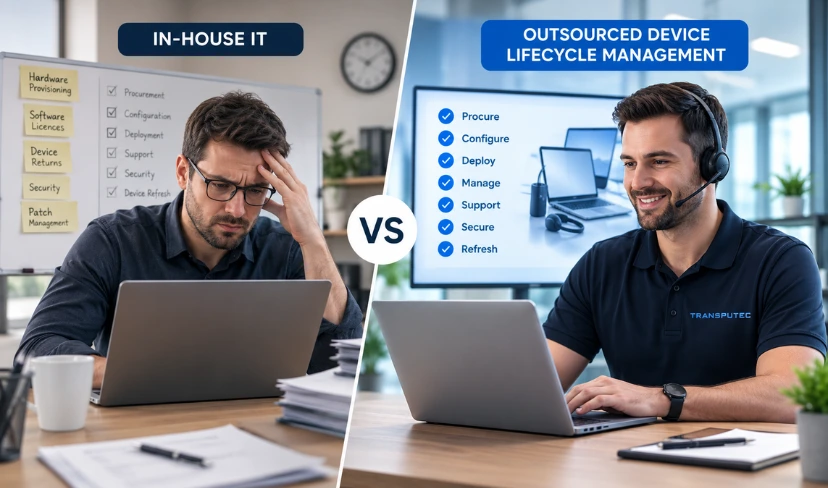
They differ far less on capability than on coverage, evidence and resilience. Most internal teams can do the work. The question is whether they can do all of it, consistently, while also doing everything else on their plate. Set against each other, the in-house vs outsourced IT asset management UK comparison looks like this.
| Factor | In-House IT | Outsourced Provider |
|---|---|---|
| Accountability | Shared across internal teams | Contractual, single named party |
| Coverage | Limited by headcount, leave and attrition | Continuous, under agreed service levels |
| Cost model | Mostly hidden internal labour | Defined cost per device, per month |
| Audit evidence | Reconstructed when requested | Produced continuously as standard |
| Remote recovery | Ad hoc chasing by IT or HR | Tracked collection with chain of custody |
| End of life | Storage, then a rushed decision | Certified destruction and value recovery |
| Scaling up | Requires new headcount | Absorbed by the provider |
| Security controls | Vary with team maturity | Certified and independently audited |
For a single-site organisation with fifty devices and a settled team, in-house remains entirely sensible, and an honest outsourced IT asset management company will tell you so. Past a few hundred devices spread across locations, the hidden labour in the left-hand column tends to exceed the service fee that would replace it.
What Should a CISO Look for in an IT Asset Disposition Provider?
Look for evidence rather than assurances. Any credible IT asset disposition provider UK-side should be able to produce documentation for each of the following without preparation:
- Certifications: ISO 27001 for information security, plus Cyber Essentials Plus as a baseline for the provider’s own estate.
- Data destruction standard: erasure to a recognised standard with a per-asset certificate, not a blanket statement covering a pallet.
- Chain of custody: a documented handover at every transfer point, from the user’s front door to the destruction facility.
- UK facilities and vetted staff: clarity on where devices are physically handled and by whom.
- System integration: asset data flowing into your CMDB and MDM rather than living in the provider’s spreadsheet.
- Exit terms: how asset data and residual value return to you if the contract ends.
Device configuration should follow recognised baselines such as NCSC device security guidance. Transputec runs its device lifecycle management service under ISO 27001 controls from a London warehouse and UK engineering bench, with the full list of accreditations set out on our certifications page.
How Do You Work Out the ROI of Outsourcing Laptop Lifecycle Management?
Compare the fully loaded internal cost per device per year against the service fee, then add the two things a spreadsheet usually misses: risk avoided and residual value recovered. Outsourced laptop lifecycle management ROI is rarely won on hardware price alone, because that is the one area where a capable internal buyer can already compete.
A workable method:
- Count every device you can account for, then estimate the ones you cannot. The gap is your first finding.
- Time your own provisioning, support, recovery and disposal activity for one month, then extrapolate.
- Apply a fully loaded internal hourly rate, including management overhead and holiday cover.
- Add the capital sitting in swap stock and in retired devices awaiting disposal.
- Compare the total against a per device, per month service fee covering the same scope.
Organisations that run this exercise honestly commonly find hardware and lifecycle spend falls somewhere in the region of 12 to 28 per cent in the first year, largely by removing duplicate departmental purchasing, extending useful device life, and recovering residual value at disposal rather than writing it off. The point of comparison is not the laptop price. It is whether an outsourced IT asset management company removes more internal cost than it adds. The benefits of outsourcing device management for CISOs show up separately, in evidence that already exists when the auditor asks for it.
When Should You Outsource IT Asset Lifecycle Management?
Outsource when the internal time spent on the estate exceeds what a service fee would cost, or when you cannot answer a basic assurance question about it. A few signals are reliable:
- Nobody can produce an accurate count of devices held by people who have left.
- New starters routinely wait more than a few days for a configured device.
- Retired hardware is accumulating with no destruction certificates on file.
- Device faults are handled as fresh purchases because there is no swap stock.
- Asset data lives in a spreadsheet that one person maintains.
- An audit request for disposal evidence would take days to answer.
Three or more of those and the case for an outsourced IT asset management company is usually already made. We set out how the managed model differs from a straightforward reseller arrangement in how Transputec’s approach differs from traditional resellers, and the offboarding-specific risks in the hidden security gap in laptop offboarding. For organisations with staff in more than one country, the argument is stronger again, as covered in managing remote worker devices across the UK, UAE and India.
Transputec normally starts with a short audit of current spend, refresh cycles and supplier list, benchmarked against authorised partner pricing, so the comparison is made on your own numbers rather than a generic case. This is a CISO guide to device lifecycle management outsourcing in the practical sense: the decision rests on where you want accountability to sit, not on which model sounds cheaper.
Conclusion
The choice is not really between two ways of buying laptops. It is between two ways of holding risk. An internal team can do every part of device lifecycle management well. What it struggles to do is cover all of it continuously, prove it afterwards, and absorb the peaks without something else slipping.
For a security leader, the deciding factors are accountability, evidence and recovery speed. If you cannot say with confidence how many devices are unaccounted for, or produce destruction certificates for last year’s retirements, the current model is already telling you something. An outsourced IT asset management company changes that by making the process, the labour and the audit trail a contractual obligation rather than somebody’s spare capacity.
Transputec runs that model for UK organisations, covering procurement, imaging, deployment, in-life support, recovery and certified disposal under ISO 27001 controls, with UK engineers and a UK warehouse behind it. If your next refresh is on the horizon, it is worth testing the numbers before it commits you for another four years.
FAQs
What Is the Difference Between In-House and Outsourced IT Asset Management?
The difference is where accountability and evidence sit, not who is capable of doing the work. In-house teams absorb lifecycle tasks alongside their other duties, with coverage limited by headcount and leave; an outsourced IT asset management company takes contractual responsibility for the full chain and produces the audit trail as standard. Transputec’s device lifecycle management service covers every stage from a UK warehouse.
What Is Included in a Managed ITAD Service?
A managed ITAD service for enterprise UK organisations covers secure collection, verified data destruction to a recognised standard, per-asset certification, compliant recycling under the WEEE Regulations, and recovery of residual value from devices still worth something. The certificates are the part that matters when an auditor asks how you know the data is gone.
How Much Does Outsourced IT Asset Management Cost in the UK?
Pricing is normally structured per device per month, with the band set by device class, support tier and whether hardware is included as an operating cost. An outsourced IT asset management company will scope against your actual fleet rather than quote blind, since location spread and support expectations move the number significantly. Transputec’s Device as a Service page explains how the per-user model is put together.
Does Outsourcing Device Management Reduce Security Risk?
It reduces risk where the risk actually sits: unrecovered devices, inconsistent wiping and missing disposal evidence. It does not remove your accountability as data controller, so the provider’s certifications, chain of custody and destruction records become part of your own control set. Assess them the way you would assess any supplier handling company data, and check the accreditations behind the claims.
When Is It Better to Keep IT Asset Management In-House?
Keeping it in-house makes sense for smaller, single-site estates with a settled team, predictable refresh cycles and devices that rarely leave the building. The case shifts once the fleet is distributed, headcount is tight, or you need audit evidence you cannot currently produce. Our post on software asset management works through the same in-house versus outsourced question on the licensing side.
This article was drafted with AI assistance and reviewed by the Transputec team. Featured image: AI-generated.