Every laptop issued to a remote worker starts a clock. From unboxing to secure decommission, how you manage that device shapes your security posture, your IT spend, and your team’s ability to work without friction.
For IT leaders managing distributed workforces across the UK, device lifecycle management is no longer a back-office function. It is a business-critical discipline that connects procurement costs, endpoint security, compliance obligations, and operational efficiency into one continuous process.
Device lifecycle management is the structured process of procuring, provisioning, securing, maintaining, refreshing, and retiring IT assets throughout their working life. For remote and hybrid teams, this spans the full journey from device imaging and shipping to a home address, through in-life patching and remote support, to certified data erasure and responsible disposal at end of life.
Transputec provides end-to-end device lifecycle management for UK businesses with distributed workforces. This pillar page covers every stage of the lifecycle in detail: what it involves, why it matters for remote teams, and what a managed approach delivers for your organisation.
What Is Device Lifecycle Management?
At its core, device lifecycle management covers the complete journey of an IT asset within your organisation:
- Procurement: Selecting and acquiring hardware through structured sourcing, with agreed specifications, pricing, and supplier SLAs
- Imaging and provisioning: Configuring devices with the correct OS build, security policies, and applications before they reach end users
- Deployment: Getting devices to users quickly and securely, including remote workers receiving kit directly at home addresses
- In-life management: Continuous monitoring, patching, remote support, and break/fix management throughout the device’s working life
- Refresh: Replacing aging hardware on a planned cycle before performance and security risks accumulate
- Secure decommission: Certified data erasure, asset recovery, and environmentally responsible disposal or remarketing at end of life
Each stage carries both a cost and a risk. Managing the lifecycle deliberately, rather than reactively, reduces both. Our overview of device lifecycle management fundamentals provides a deeper introduction if you are approaching this topic for the first time.
Why Remote Teams Make Laptop Lifecycle Management More Complex
Laptop lifecycle management for a collocated team is operationally demanding. For a distributed workforce, it becomes significantly more complex at every stage.
Devices are geographically dispersed. You cannot physically inspect or triage them on demand. Deployment requires packaging and logistics rather than a walk to the IT cupboard. Break/fix support must operate remotely, or through a next-business-day replacement programme. Data erasure at end of life requires a managed returns process with certified wipe.
Security is the sharper concern. Without physical proximity to your devices, security policies must be enforced entirely through remote management tooling: mobile device management, patch automation, and endpoint monitoring. A device that falls outside your management perimeter creates an uncontrolled exposure.
This is why laptop lifecycle management services UK providers have become a meaningful operational choice for businesses beyond a certain scale of remote working. The overhead of managing device lifecycles in-house typically exceeds the cost of a managed service once remote headcount reaches a critical mass.
Is Your Remote Device Fleet Managed End to End?
Transputec provides managed IT asset lifecycle services for remote workers across the UK, covering procurement, imaging, deployment logistics, in-life support, and secure decommission. Speak to our team about what a structured approach would look like for your organisation.
Get a Strategic ConsultationThe Five Stages of IT Asset Lifecycle Management for Remote Teams
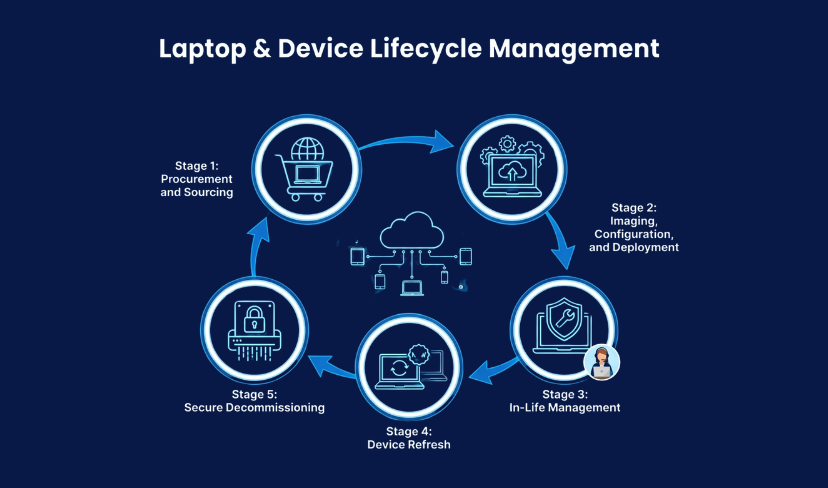
IT asset lifecycle management for remote workers moves through five distinct stages. Each stage requires deliberate planning and clear ownership to avoid gaps that create cost, security risk, or operational disruption.
Stage 1: Procurement and Sourcing
The lifecycle begins before a device is unboxed. Structured procurement means defining standard hardware specifications per role, negotiating volume pricing with approved vendors, and maintaining visibility over lead times and delivery windows.
For remote teams, procurement must account for home delivery logistics. Devices need to arrive configured and ready to use, not requiring the user to contact IT on day one for setup assistance. Poor procurement planning is the root cause of most deployment delays.
Transputec’s IT procurement services cover sourcing, configuration, and logistics for distributed workforces, ensuring devices arrive on time and ready to use.
Stage 2: Imaging, Configuration, and Deployment
Before dispatch, every device must be imaged with the correct OS build, security baseline, and application stack. Zero-touch provisioning via Microsoft Autopilot ships devices directly to a remote worker’s home address, enrolling automatically into your Azure AD tenant on first boot with no manual IT staging required. Deviations from the configuration baseline are what create audit findings and security incidents.
Stage 3: In-Life Management
Once deployed, devices require continuous management across their working life. For remote workers, this means automated patch management, endpoint monitoring via RMM tooling, MDM policy enforcement, remote break/fix support, and compliance reporting, all delivered without physical access to the device.
Stage 4: Device Refresh
Hardware has a finite useful life. A planned three-to-five year refresh cycle converts reactive replacement costs into a predictable budget line. For remote teams, refresh requires imaging and shipping a replacement to the user’s home address and recovering the outgoing asset via a managed returns process.
Stage 5: Secure Decommissioning
At end of life, devices must be collected, data-wiped to certified standards, and disposed of through a compliant WEEE recycler. Under UK GDPR, organisations are responsible for ensuring personal data on decommissioned devices is properly destroyed. An uncollected or un-wiped device is a live data breach risk.
The sections below cover each stage in detail.
Zero-Touch Deployment: Getting Devices to Remote Workers Faster
Zero-touch deployment removes the requirement for IT to physically handle a device before it reaches the end user. Using Microsoft Autopilot, devices can be shipped directly from the supplier to the remote worker’s home address, with the device automatically enrolling into your Azure AD tenant and applying all policies and applications on first boot.
For IT teams managing geographically dispersed workforces, this eliminates the staging step entirely. Devices arrive pre-configured in the user’s hands without requiring a courier trip to head office or manual imaging by a technician.
The practical impact is significant. Remote starters receive their kit on day one, fully configured and policy-compliant. IT avoids the operational overhead of a physical provisioning process. The fleet’s management perimeter is extended to include every device from first boot.
The UK National Cyber Security Centre’s guidance on end-user device security sets out the policy baselines that zero-touch provisioning should enforce at the point of enrolment. These include encryption, screen lock, and remote wipe capability as baseline requirements for any device accessing corporate data.
In-Life Management: Keeping a Distributed Fleet Secure and Current
Once deployed, devices require continuous management across their working life. For remote workers, in-life management is almost entirely remote: there is no opportunity for a technician to walk across an office and apply a patch manually.
Effective in-life device lifecycle management for a distributed fleet covers:
- Patch management: OS and application updates deployed automatically on a defined cadence, with compliance reporting to confirm patch status across the fleet
- Remote monitoring: Endpoint health monitoring via RMM tooling to detect performance degradation, storage issues, or security anomalies before they cause downtime
- MDM policy enforcement: Mobile device management policies enforced continuously, including encryption status, screen lock, and conditional access
- Remote support: Break/fix support delivered remotely, with a next-business-day replacement programme for hardware failures that cannot be resolved without physical intervention
- Compliance reporting: Continuous visibility over patch compliance, encryption status, and software inventory across every managed device
Transputec uses Tanium for continuous endpoint visibility and control across managed fleets. Our approach to endpoint management is covered in detail in our post on Tanium for UK SMEs.
Device Refresh: Managing the Mid-Life of Your Remote Fleet
Hardware has a finite useful life. For most business laptops used by knowledge workers, a three-to-five year refresh cycle is the operational norm. Beyond that window, performance degradation, battery deterioration, and driver support gaps begin to affect productivity and security patching reliability.
For remote teams, device refresh is logistically more complex than for office-based staff. A replacement device needs to be imaged, shipped to the user’s address, and the old device recovered via a managed returns process. Without a structured programme, refresh tends to be reactive: a device fails, a user raises a support ticket, and replacement happens under pressure rather than on a plan.
A planned refresh cycle, managed as part of your laptop lifecycle management services agreement, converts this from a reactive cost into a predictable budget line. You know which devices are reaching end of life each quarter, you can batch procurement to leverage volume pricing, and users experience planned transitions rather than unplanned outages.
Secure Decommissioning: End-of-Life Device Management for Remote Teams
Secure decommissioning is the stage most frequently under-managed in distributed environments. When a device is no longer needed, the data on it remains a liability until it has been certified as erased. For remote workers, recovery of end-of-life devices requires a managed collection or returns process.
Under UK GDPR, organisations are responsible for ensuring that personal data held on decommissioned devices is properly destroyed. An uncollected laptop sitting in a former employee’s home office represents a data breach waiting to happen. Certified erasure is not a best practice; it is a compliance requirement.
End-of-life device lifecycle management for remote teams should include:
- Managed device collection with tracked courier or drop-off options
- Certified data erasure to NCSC or NIST SP 800-88 standards
- Asset disposal via an approved WEEE-compliant recycler
- Remarketing or trade-in programmes to recover residual value from retired kit
- Full audit trail from collection through to certificate of destruction
Without this process, organisations carry residual data risk on every device they have ever retired without a formal wipe.
The Business Case for Managed Device Lifecycle Services
Managing the full device lifecycle management function in-house requires dedicated IT resource, vendor relationships, logistics capability, and compliance expertise across procurement, provisioning, support, refresh, and decommission. For organisations with growing remote headcounts, the operational overhead scales with the fleet.
A managed approach consolidates these functions under a single service provider. The business case for managed IT asset lifecycle services for remote workers typically rests on five outcomes:
- Predictable cost: Fixed per-device pricing across the lifecycle replaces unpredictable break/fix and reactive replacement costs
- Security baseline: Every device in the fleet is managed to the same policy standard, with no gaps created by manual processes or knowledge gaps in the internal team
- Compliance confidence: Certified erasure, audit trails, and policy documentation support GDPR, Cyber Essentials, and ISO 27001 requirements
- Operational efficiency: IT resource is freed from logistics and procurement administration to focus on higher-value activity
- Scalability: The service scales with headcount without requiring proportional growth in internal IT staff
Transputec’s managed IT services provide the infrastructure and expertise to operate this function at scale for UK businesses with distributed workforces.
Conclusion
For UK businesses running distributed workforces, device lifecycle management is the operational foundation that keeps remote teams productive, secure, and compliant. Every stage of the lifecycle, from procurement through to secure decommission, carries costs and risks that compound when left unmanaged.
The organisations that get this right treat it as a continuous programme rather than a collection of one-off tasks. They have visibility over every device in the fleet, a planned refresh cycle, a certified decommission process, and the managed IT asset lifecycle services to operate at scale without proportional growth in internal IT resource.
Transputec provides end-to-end device lifecycle management for remote teams across the UK. Whether you are looking to bring structure to an existing fleet, scale device management as your remote headcount grows, or ensure compliance at the point of device retirement, our team can advise on the right approach for your organisation.
Contact Transputec to discuss your device lifecycle requirements.
FAQs
What is device lifecycle management for remote teams?
Device lifecycle management for remote teams is the structured process of procuring, provisioning, securing, maintaining, refreshing, and securely decommissioning IT assets used by a geographically distributed workforce. It covers the full journey from imaging and logistics to certified data erasure, ensuring every device in the fleet is managed to a consistent security and operational standard throughout its working life.
How long should a laptop lifecycle be for a UK business?
For most UK business laptops, a three-to-five year lifecycle is the recommended norm. Beyond this window, battery deterioration, driver support gaps, and hardware performance issues affect both productivity and the reliability of security patching. The right refresh point depends on the intensity of use, the device specification, and your security patching requirements, but planning refresh cycles in advance avoids the cost and disruption of reactive replacement.
What does end-to-end device lifecycle management include?
End-to-end device lifecycle management covers the complete asset journey: structured procurement and sourcing, device imaging and security configuration, deployment logistics (including zero-touch provisioning for remote workers), in-life patch management and remote monitoring, planned device refresh, and secure decommissioning with certified data erasure and compliant disposal. A fully managed service includes the audit trail and compliance documentation to support GDPR and security certification requirements.
How do you manage secure device decommissioning for remote workers?
Secure decommissioning for remote workers requires a managed device collection process, certified data erasure to recognised standards such as NIST SP 800-88, and compliant disposal via an approved WEEE recycler. Organisations should obtain a certificate of destruction for every device retired, as UK GDPR requires that personal data on decommissioned devices is properly destroyed. Without a formal collection and wipe process, retired devices represent an ongoing data breach risk.
Why should UK businesses use a managed device lifecycle service for remote teams?
Managing device lifecycle in-house across a remote workforce requires procurement expertise, logistics capability, endpoint management tooling, and compliance processes that scale with headcount. A managed IT asset lifecycle management service consolidates these functions, delivering predictable per-device costs, a consistent security baseline across the fleet, certified compliance documentation, and the operational capacity to scale without proportional growth in internal IT resource. For UK businesses with distributed teams, it is often the more cost-effective and lower-risk approach beyond a certain fleet size.