Written by SONNY SEHGAL | CEO
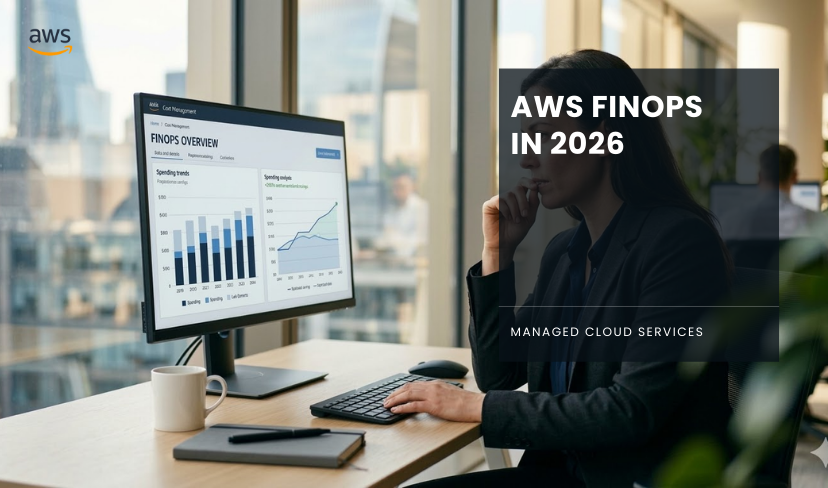
If your AWS bill keeps rising while your teams are under pressure to deliver faster, you are dealing with the same challenge facing many UK organisations in 2026. Cloud spending is no longer just an IT line item. It is tied to product delivery, resilience, data growth, security, and increasingly AI. AWS describes cloud financial management as the discipline of helping organisations manage, optimise, plan, and run cloud costs while maintaining business agility. That is exactly why FinOps matters now. It is not about putting the brakes on innovation. It is about making sure every £1 you spend in AWS is working harder for the business.
For UK businesses, this matters even more because technology investment is still moving up fast. Gartner forecasts worldwide IT spending will reach $6.15 trillion in 2026, up 10.8% from 2025, with AI infrastructure remaining a major driver. Closer to home, UK government data published in January 2026 found that around 83% of UK businesses handle digital data, showing how dependent organisations now are on digital platforms, infrastructure, and cloud-backed operations. When so much of your business runs on data and cloud services, uncontrolled spend becomes a business risk, not just a finance issue.
FinOps is now about value, not just savings
The old view of FinOps was fairly narrow. It was often seen as a clean-up exercise to reduce waste after cloud costs had already got out of hand. In 2026, that is too limited. The FinOps Foundation’s latest State of FinOps data shows the discipline has expanded well beyond core cloud infrastructure. Around 98% of practitioners now manage AI spend, 90% manage SaaS or expect to within the year, and 64% manage software licensing. That tells you something important: FinOps is becoming a broader operating model for technology value.
In practical terms, that means you need to balance speed, cost, governance, and outcomes. You do not want engineers afraid to launch something useful because of budget pressure. But you also do not want overprovisioned instances, forgotten storage, idle development environments, or AI experiments running unchecked over the weekend. A mature FinOps approach gives you a clearer way to make those trade-offs.
That is why many organisations turn to partners that can manage both the technical and operational sides of cloud spend. Transputec’s AWS Managed Services are built around ongoing optimisation, governance, monitoring, and support, while its Managed Cloud Services help businesses keep cloud environments secure, scalable, and easier to control.
Where AWS waste usually shows up?
Most cloud waste is not caused by one dramatic mistake. It tends to build quietly over time.
You might have EC2 instances that were sized for peak demand and never reviewed. You might be storing old snapshots that nobody needs, paying for unattached EBS volumes, keeping non-production environments running overnight, or moving data between regions more often than necessary. In some environments, the bigger issue is not technical waste but poor visibility. Teams simply do not know which costs belong to which service, department, or application.
AWS is clear that cost optimisation is a continual process over the life of a workload, not a one-off exercise. The Cost Optimisation pillar of the AWS Well-Architected Framework is designed around building systems that deliver business value at the lowest practical price point, while still supporting outcomes.
If your estate has grown quickly, it often helps to step back and review the structure underneath it. A better cloud foundation makes cost control easier. That is where services such as Cloud Migration Services and AWS Landing Zones can support cleaner account design, stronger governance, and more predictable cost ownership from the start.
Make AWS FinOps Work Harder for Your Business in 2026
Turn rising AWS costs into measurable value, not waste. Speak to Transputec’s cloud and AWS FinOps specialists to review your current estate, identify quick wins, and build a governance model that supports both innovation and cost control.
Visibility comes first
You cannot control what you cannot see. One of the biggest reasons FinOps programmes fail is that finance sees one version of spend, engineering sees another, and leadership gets a delayed summary that arrives too late to influence decisions.
Your teams need timely, shared visibility into what is being spent, where it is being spent, and why. That includes tagging standards, business-aligned reporting, workload-level dashboards, and clearer ownership. AWS frames this through four cloud financial management pillars: see, save, plan, and run. The order matters. You start with visibility, then act on it.
This is also where operational maturity matters. If you already have the right support model in place, FinOps becomes easier to embed into day-to-day delivery. Services like Managed IT Services, Managed IT Service Desk, and IT Consultancy Services help connect reporting, governance, and service delivery so cloud costs are not being reviewed in isolation.
Put engineers closer to the cost conversation
If cost decisions are only reviewed at month-end, you are already too late. In 2026, effective FinOps means giving engineering teams enough context to make better decisions earlier.
That does not mean turning developers into accountants. It means helping them understand the cost impact of choices around compute, storage, architecture, data transfer, and scaling. When teams can see those trade-offs earlier, they can design more efficiently without slowing delivery. That is especially important for AI workloads, where experimentation can be valuable but also expensive if left unmanaged. The FinOps Foundation’s 2026 findings show that AI spend is now a mainstream FinOps concern, which reflects how quickly cloud cost management has changed.
This is one reason AI Consulting Services can sit naturally alongside AWS FinOps. If your business is rolling out AI solutions, you need the same discipline around value, governance, and measurable outcomes that you apply to the rest of your cloud estate.
Use automation to remove routine waste
Manual reviews still have value, but they are not enough on their own. The best FinOps teams automate the obvious controls so people can focus on higher-value decisions.
That might include shutting down non-production environments outside working hours, flagging idle resources, cleaning up unused storage, rightsizing instances, or applying commitment-based pricing where demand is steady. AWS states that Savings Plans can reduce eligible usage costs by up to 72% compared with On-Demand pricing, while EC2 Spot Instances can deliver discounts of up to 90% for fault-tolerant workloads. These tools are useful, but only when matched to the right workload patterns and supported by proper governance.
The point is not to cut spending blindly. It is to stop paying for things that do not create value, so you can redirect budget to the workloads that do.
Do not separate FinOps from security and resilience
A cloud estate that is hard to secure is often hard to optimise too. Poor governance, inconsistent identity controls, weak monitoring, and reactive operations all increase the odds of wasted spend. They can also make incidents more expensive when they happen.
That is why cost discipline should sit alongside cloud security and resilience planning. Transputec supports this wider view through Cyber Security Services, ThreatSpike, Penetration Testing Services, and DRaaS – Disaster Recovery as a Service. The aim is not just to make your AWS environment cheaper. It is to make it safer, more stable, and more predictable to run.
Innovation does not need to slow down
The strongest FinOps programmes in 2026 are not the ones that say no the most. They are the ones that help teams move quickly with better financial discipline.
If you build visibility into the platform, give teams clearer ownership, automate routine waste removal, and align cost control with security and resilience, you can reduce cloud waste without turning innovation into a bottleneck. That is the real purpose of AWS FinOps now. It is not about spending less at all costs. It is about spending with more intent.
If you want to make your AWS environment leaner, more accountable, and easier to scale, Transputec can help you bring together optimisation, governance, and support through its AWS and cloud services portfolio.

Ready to Experience the Transputec Difference?
Contact us today to schedule a consultation with our experts.
FAQs
1. How can AWS FinOps help my UK business cut cloud waste without slowing innovation?
AWS FinOps helps your UK business align AWS spending with product delivery, AI initiatives, and resilience so every pound spent drives measurable value instead of silent waste. It focuses on visibility, governance, and workload-level optimisation, so teams can move fast while staying within clear financial guardrails. Transputec supports this by combining AWS Managed Services and Managed Cloud Services to continuously rightsize, monitor, and optimise your AWS environment while keeping it secure and scalable.
2. What does a mature AWS FinOps model with Transputec actually look like in practice?
A mature AWS FinOps model with Transputec starts by building shared visibility across finance, engineering, and leadership through tagging standards, dashboards, and business-aligned reporting. From there, Transputec layers in automation for rightsizing, non-production shutdowns, storage clean-up, and commitment-based pricing, backed by its AWS Managed Services and AWS Landing Zones for strong governance. This operating model makes cost control part of day-to-day delivery, not a one-off audit.
3. How does Transputec use AWS FinOps to manage the costs of AI and data-heavy workloads?
AI and data-heavy workloads can create unpredictable AWS bills, so Transputec applies AWS FinOps principles from the design stage onward. Its AI Consulting Services help you choose architectures, storage strategies, and scaling patterns that balance experimentation with financial discipline. Combined with ongoing monitoring and optimisation across EC2, storage, and data transfer, Transputec ensures AI initiatives remain sustainable while still supporting rapid innovation.
4. In what ways do security and resilience services from Transputec strengthen AWS FinOps outcomes?
Poor security and resilience often lead to hidden AWS waste, from overprovisioned resources to expensive incident recovery. Transputec’s Cyber Security Services, ThreatSpike, Penetration Testing Services, and DRaaS are integrated with its cloud optimisation work so governance, identity, and monitoring are consistent across your AWS estate. This reduces both risk and unnecessary spend, making your environment not just cheaper, but safer and more predictable to run.
5. How would Transputec start an AWS FinOps engagement for an estate that has grown too quickly?
For a fast-growing AWS estate, Transputec typically begins with a visibility and foundation review, mapping spend to workloads, business units, and applications to uncover where waste and poor ownership exist. It then uses services such as Cloud Migration Services and AWS Landing Zones to rationalise accounts, enforce tagging and governance, and establish clearer cost ownership. From there, Transputec’s AWS Managed Services team embeds ongoing optimisation and reporting so FinOps becomes a continuous practice rather than a one-off clean-up.