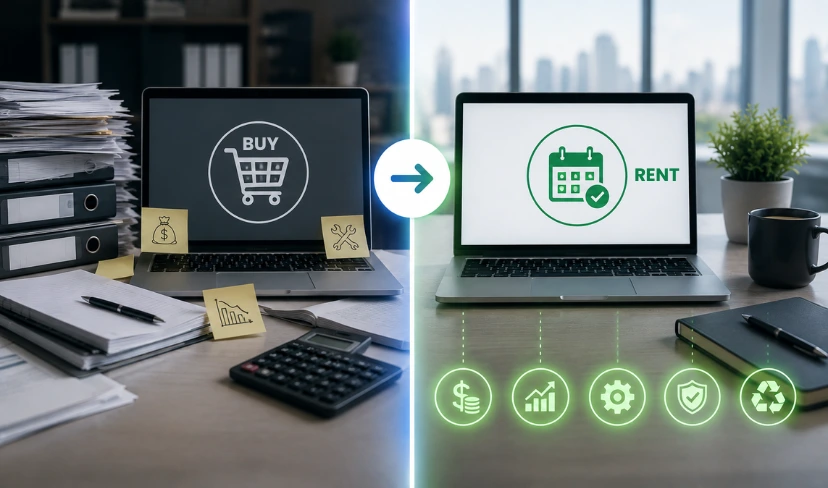
A finance director in Dubai signs off sixty laptops. The invoice is large, but the decision feels clean. Buy once, own the asset, move on.
Three years later the same sixty machines are slow, out of warranty, and sitting in an office nobody has budget to refit. Twelve went home with leavers and never came back. Nobody can say which twelve.
That gap between the purchase decision and what it costs to live with is why laptop rental Dubai options get a second look from finance teams who have been through one full cycle.
This article compares leasing and buying laptops for a business in Dubai: what each one really costs across three years, how the choice affects cash flow and VAT, when buying still wins, and how to build a business case that holds up. If you are about to sign off a hardware purchase, start with the cost breakdown.
What Is the Real Choice Here?
Leasing means paying a monthly fee to use laptops a provider owns, usually with support and disposal bundled in. Buying means paying once, owning the asset, and carrying everything that follows: configuration, warranty administration, replacements, storage and eventual disposal.
The comparison most people run is the purchase price against thirty-six monthly payments. That comparison is wrong, because it prices only one side of the deal.
The real question is not which option costs less on paper. It is which costs less once you count the work. Laptop rental Dubai providers build that work into the fee. When you buy, it lands on your team and never appears on an invoice.
Why UAE Businesses Get This Decision Wrong
Because the cost of ownership sits with people who do not report to finance. The IT manager who spends a day imaging machines, the office manager chasing a courier, the operations lead keeping spares in a cupboard. None of that time shows up as a hardware cost.
Dubai adds its own friction. Importing kit means customs clearance and lead times. Warranty repair depends on whether your supplier is an authorised partner or a box shifter. And headcount moves with project cycles, so the number of laptops you need in March is rarely the number you need in November. That volatility is what pushes finance teams towards IT equipment leasing UAE arrangements in the first place.
Not Sure Which Way the Numbers Fall?
Tell us your headcount, refresh cycle and current hardware spend, and we will work through the leasing and buying comparison using your actual numbers instead of a generic template.
Get a Strategic ConsultationWhat Does It Actually Cost to Buy Laptops in Dubai?
Considerably more than the purchase price. Buying looks simpler than a laptop rental Dubai contract right up until you total the work attached to it.
A purchase carries:
- The device itself, plus import duty and 5% VAT.
- Configuration and imaging, either as your team’s time or a supplier charge.
- Extended warranty if you buy it, or downtime if you do not.
- Spares held on a shelf so one failure does not stop someone working.
- Asset tracking and storage across the full three years.
- Disposal at the end, including secure data erasure.
The last one catches people out. A laptop you own is a laptop you remain responsible for at end of life, and that responsibility does not stop when the machine stops being useful.
What Does Laptop Rental Dubai Cost Compared With Buying?
It moves most of those line items into one monthly figure, which makes the total predictable even where it is not always lower. Here is how the two compare across a standard three-year cycle.
| Cost area | Buying outright | Laptop rental |
|---|---|---|
| Upfront cash | Full amount on delivery | None, spread monthly |
| Balance sheet | Capital asset, depreciated | Operating expense |
| Configuration | Your team, or a per-device charge | Usually included |
| Warranty and repair | You manage the claim | Provider manages the claim |
| Replacement on failure | Buy another, or hold spares | Covered by the agreement |
| Scaling down | You own the surplus machines | Depends on contract terms |
| End of life | Yours, including certified erasure | Handled and certified by provider |
| Cost visibility | Scattered across several teams | One line per user per month |
The table is the argument. Buying wins on the headline number in plenty of cases. Laptop rental Dubai wins on the rows nobody puts in the budget.
When Does Buying Still Make More Sense?
When your headcount is stable, your cash position is comfortable, and you keep machines longer than four years.
Buying wins in a few specific situations:
- Specialist hardware with a long useful life, such as workstations for engineering or design.
- Teams whose size barely changes from year to year.
- Organisations with in-house IT capacity already paid for, where configuration and support are not incremental costs.
- Businesses holding cash they cannot put to better use elsewhere.
Anyone telling you laptop rental Dubai always beats buying is selling rental. The honest answer turns on how much your headcount moves and how much IT capacity you already have on payroll.
How Does the Choice Affect Cash Flow and VAT?
Buying takes a large amount of cash out in a single quarter. Laptop rental Dubai agreements spread it, and for a growing business that shape usually matters more than the total.
On tax, the treatment differs between a one-off purchase of goods and a recurring supply of services, and the timing of recovery moves with it. UAE VAT is charged at 5%. The Federal Tax Authority publishes the guides and public clarifications your finance team should work from. Confirm the position for your entity with them or your tax adviser, not with a hardware supplier.
Free zone companies have further considerations depending on the zone and the nature of the supply. Do not assume a mainland answer applies to a DMCC or JAFZA entity without checking it.
What Happens at the End of Three Years?
With a purchase, you own sixty ageing laptops and a disposal problem. With corporate laptop leasing UAE arrangements, the provider collects them and the refresh is already scheduled.
End of life is where the two models separate most sharply. Owned machines need secure erasure before they leave the business, because a retired laptop still holds personal data. Under Federal Decree-Law No. 45 of 2021, that data must be securely deleted once it is no longer needed for its purpose. The UAE government’s summary of its data protection laws sets out the framework.
Ask any provider what its certificate shows. You want individual serial numbers, the erasure standard used and a named signatory, not a total weight and a quantity. Our device lifecycle management service covers collection through to certified disposal with that evidence attached.
How Do You Build the Business Case?
Put both options on the same three-year horizon and price the labour, not only the hardware.
A method that works:
- Count your devices and split them by role, since not everyone needs the same machine.
- Price the purchase route in full, including duty, VAT, imaging, spares, warranty and disposal.
- Get a per-user monthly quote from a laptop rental Dubai provider and confirm exactly what sits inside it.
- Estimate the internal hours spent on procurement, imaging, warranty chasing and device collection, then cost them at a loaded rate.
- Model a headcount change of plus or minus twenty per cent and see which option absorbs it more cheaply.
- Compare the three-year totals, then compare the two cash flow shapes.
Step four decides most of these arguments. Skip it and you are comparing a complete cost on one side against a partial one on the other. Transputec’s Device as a Service bundles hardware, configuration, support and disposal into one per-seat fee, which makes the like-for-like comparison much easier to run. If you want the model explained first, our post on how Device as a Service actually works covers the mechanics.
Conclusion
Buying laptops looks cheaper because the invoice is the only number anyone sees. The rest of the cost is real. It just arrives slowly, and it lands on people whose job is meant to be something else.
Neither model is automatically right. A stable team with in-house IT and spare cash can buy well. A company whose headcount moves with project cycles, importing hardware into Dubai and losing machines to leavers, will usually do better spreading the cost and handing the work to someone whose job it is.
Run the comparison properly before the next purchase order goes out. Price the labour, model a headcount change, and look at the three-year total rather than the quote in front of you.
Transputec manages device fleets for UK and international organisations, holding ISO 27001, Cyber Essentials Plus, and Lenovo and Dell Gold partner status. Talk to our team if you want the laptop rental Dubai and buying numbers worked through against your actual headcount.
FAQs
Is It Cheaper to Lease or Buy Laptops for Employees?
It depends on how much your headcount moves and how much IT capacity you already have. Buying tends to win where teams are stable, machines are kept beyond four years, and configuration and support are handled in-house at no extra cost. Leasing tends to win where headcount swings, there is no dedicated IT function, or cash is better used elsewhere. Compare the full three-year cost of both, including the internal hours, rather than the purchase price against the monthly fee.
What Is the Difference Between Laptop Rental and Device as a Service?
Rental gives you the hardware and a payment plan. Device as a Service adds configuration, deployment, support, replacement and certified disposal under the same monthly fee. With plain rental, your team still images the machine, chases the warranty and works out what to do with it at the end. Transputec’s Device as a Service covers the full lifecycle.
How Long Are Business Laptop Leases in Dubai?
Most laptop rental Dubai agreements run for thirty-six months, matching a standard refresh cycle. Shorter terms of twelve or twenty-four months exist and cost more per month. Longer terms lower the monthly figure but tie you to hardware that will be four or five years old by the end. Check the terms for growing or shrinking the seat count mid-contract before you commit to any length.
Can You Buy the Laptops at the End of a Lease?
Often yes, through a buyout option at the end of the term, though the price and the process vary by provider. Get the buyout terms written into the agreement at the start rather than negotiating them in the final month. Also confirm who is then responsible for erasure and disposal, because buying the devices moves that duty back to you.
What Happens to Company Data on Returned Laptops?
It should be securely erased to a recognised standard, with a certificate listing each device by serial number. Under Federal Decree-Law No. 45 of 2021, personal data must be securely deleted once it is no longer needed, and a returned laptop still holds it. Ask to see a sample certificate before signing, and check who carries the liability if a device goes missing in transit. Our device lifecycle management service handles collection through to certified disposal.
This article was drafted with AI assistance and reviewed by the Transputec team. Featured image: AI-generated.