AI cybersecurity is not a replacement for traditional tools; it is a significant upgrade to how those tools work. For UK SMEs, the real question is not which approach wins but how to combine both intelligently to protect your business without burning through budget or drowning your team in alerts.
Cyber threats are not slowing down. If anything, 2026 is shaping up to be the most complex year yet for UK businesses of all sizes. Ransomware, phishing, supply chain attacks, and AI-generated social engineering are converging, and the attackers are using the same tools you are evaluating right now.
So where does that leave you as a business leader? You need answers, not a lecture on how the threat landscape is changing. This post gives you a clear-eyed view of AI vs traditional cybersecurity, what each delivers, what each misses, and what a pragmatic approach looks like for a growing UK business in 2026.
What Do We Actually Mean by Traditional Cybersecurity?
Traditional cybersecurity refers to the rule-based tools and processes that have protected business networks for the past two decades. Firewalls, antivirus software, signature-based threat detection, VPNs, and manual security audits all fall into this category.
These tools work by matching known threats against a database of signatures or rules. If the pattern matches, the system flags or blocks it. Straightforward in theory and genuinely effective against known, catalogued threats.
The problem is that the threat environment has long since outrun the rule book.
- Signature-based tools miss zero-day attacks by definition
- Rule-based systems generate enormous volumes of alerts, most of which are false positives
- They require constant manual updates and expert review to remain effective
- They offer limited visibility into user behaviour or unusual patterns inside your network
For a business running lean IT, this creates a real operational cost; either you over-invest in headcount to manage the noise, or you under-react and leave genuine threats unaddressed.
What Does AI Cybersecurity Actually Add?
AI cybersecurity solutions use machine learning to detect threats based on behaviour, not just known signatures. Instead of asking, “Does this match a pattern we have seen before?” they ask, “Does this look unusual given everything we know about normal activity in this environment?”
That shift matters enormously in practice.
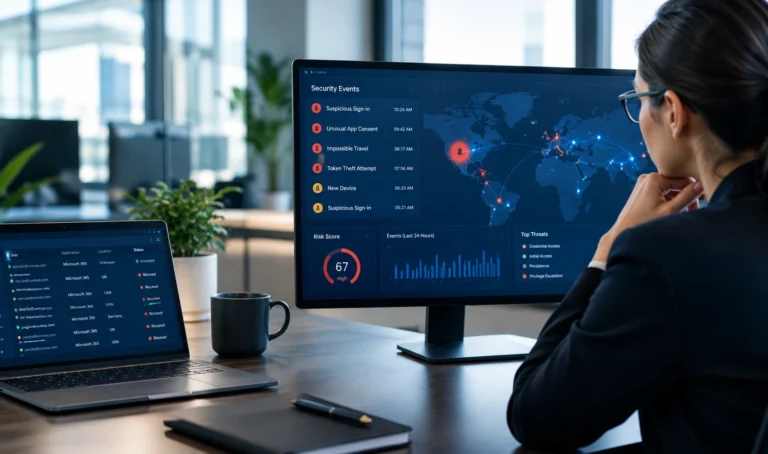
- Anomaly detection: AI flags when a user account suddenly downloads 50GB of data at 2 am, even if no rule was written for that specific scenario
- Faster response: Automated threat containment can isolate a compromised endpoint in seconds, not hours
- Reduced alert fatigue: AI correlates signals across your environment and surfaces only high-confidence incidents
- Adaptive learning: Models update continuously as your environment changes, without requiring manual rule updates
- Predictive insight: Some platforms can identify attack vectors before they are exploited by correlating threat intelligence with your specific configuration
This is not hypothetical. A UK professional services firm using AI-powered endpoint detection through Transputec identified a compromised contractor account within 11 minutes of the first suspicious action, before any data left the network. Under a traditional signature-only approach, the same incident would likely have gone undetected for days.
Ready to Understand Your Real Security Posture?
We will review your current environment, identify the gaps, and show you exactly how AI-powered managed cybersecurity could work for your business.
AI vs Traditional Cybersecurity: A Direct Comparison
1. Detection capability
Traditional tools excel at blocking known threats. AI tools excel at identifying unknown ones. In 2026, most attacks use novel techniques, so detection capability tilts significantly toward AI.
2. Speed of response
Traditional tools require human review before action. AI-powered systems can automate containment in real time. For ransomware, that time difference is often the difference between a contained incident and a company-wide encryption event.
3. Operational burden
Traditional tools demand more human resources to manage, tune, and review. AI tools automate much of that work, which is particularly relevant if your internal IT team is small or stretched.
4. Cost and complexity
This is where it gets nuanced. AI security platforms carry higher licensing costs in isolation. But when you factor in the analyst time saved, the incidents prevented, and the regulatory exposure avoided, the ROI calculation shifts substantially. Transputec’s managed cybersecurity services bundle AI tooling with 24/7 expert oversight, which removes the need for significant in-house security headcount.
5. False positives
Traditional tools produce excessive false positives, overwhelming teams. AI reduces this significantly through correlation and context, though no system is perfect. Supervised AI with human-in-the-loop review is the current gold standard.
Is AI Better Than Traditional Cybersecurity for SMEs?
Not by itself, and that is an important distinction. The most effective security programmes in 2026 use AI to augment and accelerate traditional controls, not replace them.
A well-configured firewall still stops known attack vectors. Endpoint protection still catches commodity malware. Multi-factor authentication still blocks the majority of credential-based intrusions. These tools do not become irrelevant because AI exists.
What AI adds is the intelligence layer that makes those traditional controls smarter. It connects the dots between what your firewall sees, what your endpoint agent logs, and what your identity system records, and surfaces the full picture in real time.
For UK SMEs, the practical implication is this: you do not need to rip out your existing security stack. You need to layer AI-driven detection and response on top of it and ensure both are managed by people who know what they are doing.
Can AI Replace Traditional Cybersecurity Tools?
No, at least not yet. AI excels at detection and triage. It still depends on underlying infrastructure controls to enforce policy, block traffic, and authenticate users. Think of AI as the analyst, not the perimeter.
What AI can replace is a significant proportion of the manual effort involved in running traditional tools. That is where the efficiency gains are real and measurable for a growing business.
What Happens If You Do Not Adopt AI Cybersecurity?
The honest answer: you fall behind the attackers. Threat actors are already using AI to craft more convincing phishing emails, automate reconnaissance, and identify vulnerabilities at scale. If your defences are purely reactive and signature-based, you are operating at a structural disadvantage.
The UK government’s Cyber Security Breaches Survey 2024 found that 50% of UK businesses experienced a cyber incident in the prior 12 months. For medium-sized businesses, that figure rises to 70%. The cost of a single ransomware incident for an SME now averages over £8,000 in immediate costs alone, excluding reputational damage and downtime.
Not adopting AI-powered detection is not a neutral decision. It is an active risk posture.
Benefits of AI in Cybersecurity for Growing Businesses
Growth creates security complexity. New users, new systems, new third-party integrations, and new attack surfaces appear faster than your IT team can manually track. AI scales with that growth in a way that a team of analysts cannot.
- Consistent coverage: AI monitors 24/7 without fatigue or holidays
- Scales without headcount: Adding 50 users does not require hiring 3 more security analysts
- Regulatory compliance: Many AI platforms generate audit-ready logs and compliance reports automatically
- Board-level visibility: AI dashboards give leadership a clear, real-time risk picture without wading through raw logs
- Insurance positioning: Demonstrating that AI-powered monitoring increasingly affects your cyber insurance premiums positively
Is Managed Cybersecurity Worth It for UK SMEs?
Yes, for most businesses below a few hundred employees, building an internal security operations capability from scratch is economically unviable. A senior security analyst in the UK commands upwards of £65,000 per year. A 24/7 SOC requires multiple analysts across shifts, plus tooling, management, and ongoing training.
Managed cybersecurity services provide that capability at a fraction of the cost, combining AI tooling with expert human oversight and a guaranteed response time. Transputec’s managed security service gives UK businesses a fully operational security posture from day one, without the recruitment, training, or infrastructure investment.
A Practical Framework: How to Assess and Upgrade Your Security in 2026
Map every tool in place – firewall, AV, EDR, identity management, and SIEM. Identify gaps, redundancies, and tools that lack modern integration capability.
Where is your sensitive data? Who has access? What are your crown jewels? This defines where AI detection needs to focus first.
Most breaches start with a compromised credential or endpoint. AI-powered identity analytics and EDR tools offer the highest return on investment here.
Do not rip and replace. Use AI as an intelligence layer above your existing infrastructure. Transputec integrates AI tooling with your current environment rather than forcing a complete rebuild.
Detection without response is incomplete. Ensure your AI tools are backed by a team – internal or managed – that can act within minutes of an alert, not hours.
Set baselines for mean time to detect (MTTD) and mean time to respond (MTTR). Use AI dashboards to report security posture to leadership monthly. This drives accountability and informs investment decisions.
What to Look for in an AI Cybersecurity Partner ?
Not every provider offering “AI security” is delivering genuine intelligence. When evaluating partners, push for specifics:
- What models are used for anomaly detection, and how are they trained?
- What is the guaranteed response time when an alert fires?
- How does the platform integrate with your existing Microsoft 365 or cloud environment?
- Can you see the threat data and investigation logs, or is it a black box?
- What does the onboarding and tuning period look like?
Transputec operates with full transparency on all of these points. Our managed cybersecurity services are built around Microsoft Sentinel and market-leading AI detection platforms, integrated into your specific environment and overseen by a UK-based security team.
Conclusion
The debate around AI vs traditional cybersecurity is largely a false choice. The businesses that get this right in 2026 are not picking one or the other; they are combining the reliability of established security controls with the intelligence and speed that AI brings.
If you are still running a security posture built on signature-based tools and quarterly manual reviews, you are not just behind the attackers; you are behind your competitors who have already made the shift.
The good news is that you do not need to build this from scratch or navigate it alone.
Transputec has helped SMEs and growth businesses across the UK build cost-effective, AI-powered security programmes that protect without paralysing and scale as you do.

Ready to Experience the Transputec Difference?
Contact us today to schedule a consultation with our experts.
FAQs
1. Is AI cybersecurity suitable for small UK businesses, or is it only for large enterprises?
AI cybersecurity is not just for enterprises; in fact, SMEs arguably benefit more. Larger organisations have dedicated security teams to manage traditional tools. Smaller businesses do not, which means alert fatigue, missed threats, and slow response times are more acute problems. AI-powered managed cybersecurity services, like those offered by Transputec, give UK SMEs enterprise-grade detection and response at a cost that is proportionate to their size. The key is working with a provider that integrates AI tooling into your specific environment rather than selling you a generic platform and leaving you to manage it alone.
2. What is the actual cost difference between AI and traditional cybersecurity for a UK SME?
Traditional tools appear cheaper upfront, but the full cost includes the analyst time needed to manage them, the incidents they miss, and the downtime that follows. A single ransomware event costs the average UK SME well over £8,000 in direct costs, before factoring in lost revenue and reputational damage. AI-powered managed cybersecurity services through Transputec typically cost less per month than the equivalent in-house analyst capacity, while delivering 24/7 monitoring, automated response, and AI-driven detection that traditional tools cannot match. The ROI calculation usually favours AI-enhanced managed services within the first year.
3. How does Transputec's approach to AI cybersecurity differ from a standard IT provider?
Most IT providers offer security as an add-on, a few tools, a monthly report, and reactive support when something goes wrong. Transputec operates a fully managed security model built around AI-powered platforms, including Microsoft Sentinel, combined with UK-based security analysts who respond to incidents in real time. We integrate with your existing environment rather than forcing a rip-and-replace approach. We also work with your leadership to connect security posture to business outcomes, covering compliance requirements, cyber insurance positioning, and board-level reporting, not just technical tooling.
4. Can AI cybersecurity tools work alongside our existing Microsoft 365 and cloud environment?
Yes, and this is one of the strongest use cases for AI security right now. Microsoft 365 generates an enormous volume of identity, email, collaboration, and endpoint signals. AI tools like Microsoft Sentinel correlate those signals intelligently, surfacing genuine threats within your existing licensing rather than requiring a separate tooling investment. Transputec specialises in integrating AI-powered detection directly into Microsoft environments, meaning most UK SMEs already using Microsoft 365 or Azure can activate advanced security capabilities without a full infrastructure rebuild.
5. What should a UK business do first if it wants to shift from traditional to AI-powered cybersecurity?
Start with a security posture review. Before investing in any new tooling, you need a clear picture of what you currently have, where the gaps are, and what your most significant risk exposure looks like. Transputec offers a strategic security consultation that maps your current environment, identifies where AI-powered detection would have the most immediate impact, and outlines a phased adoption roadmap. This gives you a business case you can take to a board or budget committee, grounded in your specific risks rather than generic vendor claims. From there, most businesses can have AI-enhanced managed security operational within four to six weeks.